Showing posts with label Grocery Budget. Show all posts

Wednesday, April 6, 2011

New to Couponing? It Doesn't Have To Be Extreme

My humble coupon case:


If you are new to couponing or even the subject of saving money on groceries, watching TV shows, like Extreme Couponing on TLC, can be overwhelming or intimidating.

I guess it is possible to buy hundreds or even thousands of dollars worth of groceries for pocket change, but nobody needs 62 bottles of mustard...or 70 containers of detergent...or 40 boxes of sugary cereals.

I believe the grocery bill is one of the easiest categories of the household budget to reduce and you don't have to be an extreme couponer to accomplish the task. I use coupons but they are not my only method to reducing our grocery spending.

There are lots of ways to save money on groceries without sacrificing the quality of your diet, the time you spend with your family and your closet space. Check out these links to some of my past posts on the topic:

I DO use coupons. I use them weekly. I love finding coupons for the foods and products that we use. Aside from the newspaper inserts, you can find printable coupons at online sites, such as Coupons.com. You'll find a variety of coupons for products like:

If you get your coupons via the newspaper and you want to plan ahead? Sign up to receive an email alert of the upcoming Sunday Coupon Preview.

Do you shop at stores like: Baker's City Market Dillons Fry's Gerbes Hilander JayC King Soopers Kroger Owen's Pay Less QFC Ralphs Scott's Smith's Carrs Dominick's Genuardi's Pavilions Randall's Safeway Tom Thumb Vons ShopRite? You can sign up at CellFire Coupons and load coupons directly to your store loyalty card. You just swipe your card at checkout to redeem the coupons.

There are many ways to save money on groceries and coupons are part of it, but it doesn't have to be obsessive and it doesn't have to be extreme.

Have you heard about the new reality tv show, Extreme Couponing? Did you watch it? I watched about 30 minutes of it, but when I saw food stock piled in the master bedroom, I decided I had seen enough.

Thanks for reading. If you would like to receive FREE updates of FBS, there are four ways to do so:


Disclosure: This post contains affiliate links. See my disclosure policy for additional information.

Wednesday, March 16, 2011

How To Save Money on Organic Food | Kitchen Economics


Is eating organic food important to you? I don't like the thought of all of the pesticides, synthetic hormones and antibiotics passing through to my family, especially my two young children. So we eat a fair amount of organic, especially during the summer harvest. Have you ever eaten an organic, local, ripe strawberry?...heaven on earth.

Does the price of organic make you not buy as much as you would like? Eating organically can be expensive, so I am always looking for ways to save money on organic food.

When it comes to organic food, everyone's line in the sand is different. I have friends who are adament about eating only organic food and I have friends where eating organic is not a priority. We fall somewhere in between.

Here are 6 tips that I use to help us afford organic food:

1. Community Supported Agriculture or CSA.
A CSA is a commitment between local farmer/s and community members who pay the farmer for a seasonal membership. Each week the member receives a pre-purchased and pre-determined amount of produce and the farmer receives upfront money to run their operation. Some CSAs might require the members to volunteer hours on the farm in return for the produce.

We have been a member of a CSA for 9 years and it is the most cost-effective way for us to afford organic produce. During the May-November harvest season, we receive a weekly share of produce. Most of the produce that we consume during those months comes from the CSA. We supplement with produce we grow ourselves and I rarely need to buy produce at the grocery store during those months.

This year's price for our half-share comes to about $14.21 a week in organic produce. Obviously, prices will differ by farm. The above photo is an example of our weekly share in August when the box is full of high summer produce.

Our CSA also offers ‘OPEN Farm Days’ one Saturday each month during the harvest season. On these days, members can pick up any free extra produce that the farm has an overrun on. They also offer some extra produce at an extremely reduced rate. Last year I bought several 19 pound boxes of organic roma tomatoes for $6 each. Again, each CSA will operate differently.


I found a CSA farm directory, but you should also google to find one in your area.

2. Consider your grocery store's private label organic brand.
Just like non-organic food items, I always try the store brand to see if I/we like it. My good friend loves our store's private label vanilla organic yogurt and I didn’t care for it and went back to my beloved Stonyfield French Vanilla yogurt. Although, I don’t mind the store brand organic milk and that is usually what I purchase unless I have a brand coupon that makes the price better. It is a matter of preference, but worth some comparison shopping.

Here is a quick price comparison on a recent grocery trip:
  • Name brand 32 oz. organic yogurt $2.99 vs. store brand 32 oz organic yogurt $2.53.
  • Name brand half gallon of organic milk $4.05 vs. store brand half gallon organic milk $3.49

3. Compare price per unit and if the size makes sense go for the best price per unit.
  • Stonyfield Organic yogurt, 32 oz @ $2.99 = $1.50/lb, 6 oz cups @ .79 cents = $2.11/lb.
  • Horizon Organic Milk - half gallon @ $4.05, gallon @ $5.99

4. Look for organic or natural meat that has been marked down.
Marked down poultry or meat is safe as long as you use it or freeze immediately after you buy it. I wrote about marked down meat before and I regularly find this type of poultry or meat marked down at my store.


5. Visit your local farmers markets for organic produce, meat, poultry and dairy.

6. Visit the websites of companies that you enjoy.

Go to the websites of your favorite organic companies to look for coupons. Here are some links to a few organic sites that offer coupons. Generally there is a limit, but it usually resets every month.

How important is buying organic food to you? Do you have any tips for saving money on organic food? Let us know in the comments.

Thanks for reading. If you would like to receive FREE updates of FBS, there are four ways to do so:

Follow Me on Pinterest

This post is linked to Your Green Resource at A Delightful Home and Frugal Friday at Life as MOM.

Wednesday, March 9, 2011

Save Money On Groceries Without Using Coupons | Kitchen Economics Link Up


I am not an extreme couponer. I'm not even an avid couponer. I like coupons, but I am not the home manager who buys $200 worth of groceries for $4.35. I am always fascinated by those stories of people who are able to accomplish such a task, but it is not me. I usually average about $5 in coupons on each weekly shopping trip.

Health and Beauty products are another story. I don't buy any of those products without a coupon, but they are easier to come by. And stores like CVS and Rite Aid make it very easy for all types of shoppers to buy these products for pennies or FREE. Paper products, such as toilet paper and diapers are easy for me to use coupons too.

But I find food products to be a different story. Boxed, processed food coupons are very easy to find, but I try to limit those foods in our diet, so I really have a hard time finding coupons for food that we do eat. But that doesn't mean I don't save a lot of money at the grocery store.

Whether you are a coupon queen, king or clutz, there are many other ways to save money on groceries and coupons are not involved.

1. Menu Plan


As I have written before, groceries are the one category that I feel like I have the most control over when it comes to spending. When I plan a menu, my spending is generally under control. When I don't plan, I am sure to blow the budget. The difference between the two can be $100-$150. That is a lot of money, so I plan a menu. Develop your own routine and read my post, Eleven Tips for Easier Menu Planning for more ideas.

2. Institute a 'Raid the Fridge' Night
One night a week, raid the fridge to get rid of leftovers. Set the leftovers up buffet style. Everyone's plate might look different, but you'll at least use up the leftovers and reduce the waste.

3. Utilize the Freezer
Freeze those leftovers. If you're not going to eat the left food before it spoil, then freeze it. With the exception of maybe pasta dishes, a lot of food can be frozen. Cooked chicken and veggies can be frozen and used in soups or casseroles at a later date. Raw vegetables like carrots, peppers, onions and parsley can be shredded or chopped and bagged and stored in the freezer for future dishes.

Stockpile in the freezer. At Christmas time I bought 5 lb sacks of flour for .99 cents. I stocked up and put them in the freezer for storage and to prevent bugs. When chicken roasters are on sale at .79/lb, I buy at least 3 of them and store in the freezer. When organic bread is on sale, I stock up and store in the freezer.

4. Don't shun the store brands
I'll give the store version of a product a try and if I don't like it, I'll go back to the brand name. I buy store brand versions of many things from butter, flour and sugar to pretzels, bread, canned tomatoes and aluminum foil. There are a few instances where I went back to the name brand, like Heinz ketchup and Sargento Shredded Cheese.

I compared the prices of some store products and the name brand counterparts of some items on my shopping list and found savings of 20% - 40%.
  • Canned, diced tomatoes, 15.5 oz, store brand 59 cents vs. $1.00 for the Hunt's brand.
  • Canned red kidney beans, 15.5 oz, store brand 59 cents vs. 95 cents for Hanover brand.
  • Honey & nut O's cereal, 12.9 oz, store brand $1.99 vs. $2.79 for Cheerios brand.
  • aluminum foil, 75 square foot, store brand $2.69 vs. $3.29 Reynolds brand.

5. Compare price per unit and if the size makes sense go for the best price per unit.
I compared the price per unit of a couple different products and the sizes. Unless I think the size is too big for us to consume in time, I go for the best price per unit.
  • Heinz ketchup - 32 oz @ $2.29 = $1.15/lb, 64 oz @$3.49 = .87/lb
  • Kosher Dill Spears - 16 oz @ $2.39 = $2.39/pint, 24 oz @ $2.49 = $1.66/pint, 32 oz @$2.69 = $1.35/pint
  • Hummus (I know I can make my own hummus, but I'm proving a point here) - 8 oz @ $2.49, 16 oz @$3.98

6. Have and Know Your Buy price and Stock up.
I don't keep a price book, but for the big ticket items on my shopping list, like diapers, detergent, and chicken, I know the best price and stock up when you find it. When I see Perdue Oven Roaster Chickens at 79 cents a pound, I stock up my freezer, because that is a price that doesn't happen very often. I just focus on my most expensive pantry/freezer staple items for knowing a buy price.

7. Buy or grow local produce in season. Freeze for later use.

We live in the northeast and we are heading into asparagus season. When the price comes down to $1.49 a pound or even 99 cents a pound, we will be eating a lot of asparagus. During the winter it is usually $2.99/lb and I don't buy it. Next comes strawberry season, which after Christmas is my most favorite time of the year. There is nothing better than local, fresh, ripe strawberries picked right off the vine at a U-Pick farm for $1.30 a pound vs. $3.99/lb whitish strawberries in the winter. After that, we head in to high summer vegetable season and, well, you get the point by now...

8. Cut out the crap, save some dough.
We rarely buy sodas or other sugary drinks. On occasion we might crave root beer, but we mostly drink tap water. The same goes for junk food. The bags of Cool Ranch Doritos scream at me in the store, but I really try not cave in. For two reasons: I can't stop at just one and if it doesn't contribute to the nutrition of our family, I try to avoid it. I am not a purist though, I do splurge on occasion, but we try to limit the non-necessities.

9. Have an emergency back-up meal in the freezer or pantry
For those crazy evenings or maybe you forgot to thaw the main course, have a back up meal to avoid take-out. For me it is homemade soups that I keep in the freezer. They are easy to thaw in the microwave and I serve it with a some fruit from the fridge and I have averted a potential meal emergency.

Are you an extreme couponer or just an occasional couponer? What are some other ways, besides coupons, that you save at the grocery store? Let us know in the comments.


Welcome to the Kitchen Economics Link Up ~ Cost Cutting Tips to Help You Save Money in the Kitchen.

A few Link Up guidelines:
  • Please link a your cost-cutting kitchen tip. If you are not a blogger, please let us know your tip in the comment section.
  • Please post the link to your tip post, NOT to your homepage. To do this, click on your tip post, copy and paste the whole url address into the Link up widget.
  • I also ask that you post a link back to Family Balance Sheet in your article or grab the badge that is in the top left of the site.
  • If you are reading this post via a reader or email, you will need to click through to post your link and to visit others who have linked up.

I'm looking forward to reading your tips and saving some money in the kitchen.


Thanks for reading. If you would like to receive FREE updates of FBS, there are four ways to do so:

This post in linked to Frugal Friday at Life as Mom.

Wednesday, March 2, 2011

Eleven Tips for Easier Menu Planning | Kitchen Economics Link-Up

Groceries are the one area in our household budget that I feel like I have the most control over. The weeks that I take the time to plan the menu are the weeks that I have control over our spending. The weeks where I don’t menu plan are the weeks that I’m at the grocery store multiple times or we get take out multiple times, leading to an out of control grocery spending.

Menu planning saves me time. Sure, there is time spent upfront; about 30 minutes for me each Sunday when I plan my menu and make a grocery list. But that 30 minutes makes my grocery trip go much smoother and with a pre-planned menu, dinner hour is spent preparing the meal, not wondering, “what are we having for dinner?”.

Menu planning saves my sanity. I no longer pull my hair out at dinner hour trying to figure out what ingredients I have on hand that would go with the frozen chicken that I did not take out in the morning to thaw. Because I menu plan, I pull frozen meat from the freezer the night before my planned meal. Because I menu plan, I'm not stressed over the inevitable question around 4 o'clock in the afternoon, "mommy, what's for dinner?".

Menu planning saves me money. With less trips to the store and a pre-planned list, I am hopefully limiting any impulse and redundant purchases. I also revolve my menu around what is on sale, so I'm spending less on our meals.

Eleven Strategies for Easier Meal Planning:

1. Pick a day that works best for you to do your meal planning. I plan my menu on Sunday afternoons when I have the new week’s grocery flyer in front of me. I try to keep my large weekly grocery shopping to one store unless there are some loss-leaders elsewhere.

2. Plan your menu around what is on sale at the grocery store that week. If whole chickens are on sale for .79/pound, you can bet that my menu that week will revolve around a roasted chicken, maybe Chicken Noodle Soup or Chicken and Black Bean Quesadillas or Pulled Chicken BBQ Sandwiches. I am always looking for great sales on our staples like chicken, turkey, fruits, vegetables, bread.

3. Keep your pantry, freezer and refrigerator organized so that you can cross reference what is on sale, the ingredients needed for recipes and what you have on hand.

4. Develop a system. I started using a menu/grocery list clip board and it works really well for me. It keeps my menu and list all in one place. You could also use a blank calendar or a simple notepad.


5. Get the family involved. Ask THEM for suggestions. Every week when I ask my , kids I inevitably hear, "I want pasta". My husband will chime in, “let’s grill”. I do try to appease everyone and it makes meal time a little more enjoyable.

6. On your designated planning day, pull out the family activity calendar. What is going on in the week ahead? Will everyone be home for dinner that week? Is there soccer practice, mid-week church activities or a late night at the office? On those hectic nights, quick and easy meals will be needed. Maybe even a crock-pot meal. Are you going to a pot-luck that week or somewhere else that would require you to make and take a dish? I make those notes on my clip board and then fill in meals accordingly.

7. Plan for breakfast, lunch and dinner. On hectic mornings, life is so much easier when breakfast is planned and there are ingredients on hand. Also, my husband tries his best to come home several times a week for lunch, so I need to make sure there will be food for him.

8. Plan for all seven days. I've been lazy in the past and just planned for the work week and ignored the fact that we do need to eat on the weekends. We usually eat out one night, but if I don't plan the other six days, then it becomes more than one night out and we end up over budget in that category.

9. Create a recipe binder. My binder is a very important part of my kitchen. It is full of recipes from magazines, friends, and online that I have collected over the years. Some people keep their recipes on the computer, but I don't have a convenient spot to keep my laptop when I am cooking, so I keep my favorite recipes in a binder. The first page in the binder is a master list (see photo below) of my family's favorite, quick fix, healthy meals. It is a quick reference tool, but I don't list all of the recipes in my binder, just the family favorites that are a regular part of our meal rotation. When I look in the freezer and see several packages of ground turkey, I then look on our list under Turkey for recipes.


10. Avoid boredom by trying at least one new recipe a week, maybe on a day that isn't hectic. For those hectic days, refer to your Master recipe list for easy suggestions.

11. Do you have an ingredient, but are stumped as to what to do with it? Check websites such as CookingLight.com or Allrecipes.com where you can enter a particular ingredient and the site will recommend recipes for you. This is how I found Turkey Sausage, Arugula and Sun-Dried Tomato Pasta and Roasted Tilapia with Tomatoes and Olives, two of our my family's favorite meals. And of course, don't forget to check the Recipes Tab at Family Balance Sheet for meal ideas too.

For me, meal planning is the strategy that saves me the most money on groceries. By planning our meals around what I have on hand, what is on sale at the grocery store and what my family likes to eat, I have been able to reduce our grocery bill to a number that I am comfortable with for our budget. But that one week where I don’t menu plan or do a shoddy job on it is the week that I’ll blow my budget. Menu planning takes a little time and effort, but the rewards are a reduced grocery bill, no worries at night about 'what's for dinner', and hopefully a less stressed cook in the kitchen.

Do you plan your meals? How often do you plan? Weekly, Bi-Weekly, Monthly? Let us know in the comments.

This post is linked to Frugal Friday at Life as MOM.


Welcome to the first Kitchen Economics Link Up ~ Cost Cutting Tips to Help You Save Money in the Kitchen.

A few Link Up guidelines:
  • Please link a your cost-cutting kitchen tip. If you are not a blogger, please let us know your tip in the comment section.
  • Please post the link to your tip post, NOT to your homepage. To do this, click on your tip post, copy and paste the whole url address into the Link up widget.
  • I also ask that you post a link back to Family Balance Sheet in your article or grab the badge that is in the top left of the site.
  • If you are reading this post via a reader or email, you will need to click through to post your link and to visit others who have linked up.

I'm looking forward to reading your tips and saving some money in the kitchen.


Thanks for reading. If you would like to receive FREE updates of FBS, there are four ways to do so:

Tuesday, January 25, 2011

My Menu/Grocery List Clipboard


I am a firm believer that every one's grocery bill can be pared down with just a little bit of organization and time involvement. If you take the time to plan out your weekly menu by looking at what you have on hand and what is on sale for the week at your favorite grocery store, you can bring your grocery bill down to a more manageable level for you and your family.

This simple routine might only take 30 - 60 minutes of your time each week, but it can save you a lot of time and money once you get to the grocery store. It you stick to your list you will keep yourself on task and hopefully avoid any impulse purchases that might sneak into your cart.

Every Sunday afternoon, I grab the newspaper, my recipe binder and my clipboard and plan out our week of meals.

I don't have a fancy print out for my menu and grocery list, I use the tons of notebook paper that I have in my office from the Back-to-School sales. I think I got most of it for free or mere pennies.

My Menu
On the left side, I list options for our breakfasts and lunches and then I list the days of the week with meals for each day. I list the days, because it gives me a good visual, but you can see I switched Monday and Wednesday, because I realized a scheduling conflict. I keep the menu flexible.

My Grocery List
On the right side, I list my shopping list. I refer to the recipes that I'll be making that week to see what is needed versus what I have on hand in the pantry, freezer or fridge.

I take the clipboard with me to the store and cross items off my list as I shop. I am infamous for forgetting things at the store, so this has helped cut down extra trips later in the week.

The clipboard is also handy for holding any coupons that I'll use that day.

I also have a very simple coupon organizer that I found at Walmart years ago. It is perfect for the amount of coupons that I use.

As a side note, I saw clipboards on sale for $1 this week at either Staples or Office Max.

How do you manage your menu and grocery list? Do you agree that with a little organization, you are able to keep your grocery shopping within your budget?

If you would like to receive FREE updates of FBS, there are four ways to do so:


This post is linked to Frugal Friday at Life as MOM.


Wednesday, January 5, 2011

A Cash Experiment


Apparently, consumers spend more when they use a credit card in place of cash. I have read about this over the years and while I can't find hard evidence online backing this theory up, I have decided to do my own study.

We use a rewards credit card for almost every purchase we make. Every 12-14 months, we receive a rewards check for about $250 and put it into our vacation fund.

While $250 is certainly nice, it really isn't a lot of money anymore. Could I save even more money if we stopped using credit cards altogether and started using cash? By using a credit card, has it become too easy to put an extra book, t-shirt or bag of pretzels into my cart? And that pesky Target now offers 5% off when you use their Target Visa card on purchases at their store. The check that I write at the end of every month to pay off the credit card is not so nice.

How much money could we save if we start using cash? I have identified 3 categories that I am going to use cash for instead of handing over our credit card: groceries, restaurant meals and clothing. When I deposited our paycheck on Monday, I took out cash for these categories for the month.

These are categories that I feel I can reduce our spending. I let our grocery bill creep up this past fall. We enjoy eating out for dinner once a week, but those bills have also gotten a little high. We actually spent less on clothing in 2010 than 2009, but after looking in our closets, I just can't think of anything that we truly need. They are all pretty full.

My problem will probably be remembering to take the cash with me when I leave the house. I have used credit cards for so long that I'm not used to having cash in my wallet. I actually don't like carrying around a lot of cash. But I am committed to this experiment and I can't wait to see how well I do at the end of the month.

How do you pay for your purchases? Cash or credit?

If you would like to receive FREE updates of FBS, there are four ways to do so:

This post is linked to Frugal Friday at Life as MOM.

Image: luigi diamanti / FreeDigitalPhotos.net

Tuesday, June 22, 2010

Easy Summer Menu Planning

I write a lot about food. I love to eat and I love to cook for my family.

My favorite part of summer is the food. Well, I also love the long days and the glorious sun, but the food...oh...the food. We cook outside and we eat outside. I rarely turn on my stove or oven during the summer, opting instead for the grill and fresh garden vegetables and fruits from my own garden, the CSA or a farm stand.

The food in this picture is a typical summer meal for us. Grilled turkey sausages topped with grilled red peppers and red onions, tossed garden salad, steamed green beans and fresh summer fruit. When food is this fresh we don't get bored with it. Instead we savor it knowing that in a few months the summer harvest will be over and I am headed back into the kitchen.

Summer menu planning is so easy. We'll grill chicken, turkey sausages, turkey burgers and fish all summer long. Add a simple garden or pasta salad and some summer fruit and you have a no-frills, yet delicious meal. Easy to make, very few ingredients and fast. When the weather is gorgeous outside, who wants to be stuck inside spending a lot of time cooking dinner?

Summer menu planning can also be easy on your grocery budget. You can get local, fresh, in-season produce at great prices from farmers markets, roadside stands, u-pick farms and even your traditional grocery store.

My favorite ingredients, though, come from my own garden. You can't get much easier than going to your own back yard for your dinner. Hopefully my garden will flourish in the next several weeks and will be ready to harvest soon.

What's on your dinner table this summer? How do you save money on your grocery budget over the summer?

Are you looking for new grill recipes? Do you have an awesome grill recipe to share? Bring it to Family Balance Sheet every Monday from June 21 - August 30, 2010 and link up to the Summer Grilling Recipe Exchange.


Thanks for reading FamilyBalanceSheet. If you would like to receive FREE updates of FBS through your RSS Feed, please click here to sign up. Or Subscribe by Email. Are you on Twitter? Click here to receive updates via Twitter.

This post is linked to:

Thursday, June 10, 2010

U-Pick Strawberries: Buy Local, Save Money & Enjoy

For me, the anticipation of the local strawberry season is like the feeling I get right before Christmas. I am full of excitement and impatience all at once. The season is short, so I can’t wait for it to come and I want to savor the moment once it is here.

In my area, strawberry season is here and it might even be dwindling down in some parts…boohoo

And my Topsy-Turvy Strawberry planter has just a few green berries.


So what is a girl to do…head to the U-Pick strawberry patch, where the local berries are bursting, full of flavor and at my patch only $1.40 a pound.


I have gone twice so far and picked 8 quarts each time. I am also going to go to our CSA’s u-pick day this Saturday.

Aside from just popping them in our mouths, we have had strawberry shortcake for dessert (and maybe for breakfast too), we have added strawberries to our breakfasts and our salads, I have made 2 batches of freezer jam, and I have filled 2 gallon-sized bags for the freezer. I’ll use those for ice cream and smoothies long after the season is over and local, fresh berries are a distant memory.

Right now, I am going to go pop a few more in my mouth and savor this season for just a few more days.

Do you go to the U-Pick strawberry patch? What price do you pay for berries at your patch?


Thanks for reading FamilyBalanceSheet. If you would like to receive FREE updates of FBS through your RSS Feed, please click here to sign up. Or sign up for FREE email updates, by submitting your email address in the top left side of this site. Or click here to follow on Twitter.

This post is linked to:

Wednesday, March 24, 2010

If You Are Spending One Cent On Bath and Beauty Products, You Are Spending TOO Much!

The products in the picture did NOT cost me a single penny. I got them all for FREE and NO I did not steal them. It is easy and you can do it too.


I have mentioned before that I save an average of $5-$10 on coupons on our food per shopping trip. I don't use very many coupons on food, because I don't see too many food coupons on products that we consume. But, that is not the case for bath and body products that we use every day, such as dental and eye products, soaps, shampoos, hair gels, feminine hygiene products, and razors.

I shop for those products at stores like Rite-Aid and CVS. Walgreens is another store that offers a similar program, but it is not in my area. With a combination of coupons and those stores' rebate programs, I am able to score all of our bath and body products at no cost to us. There might be an initial out-of-pocket expense, but I will get that back in the form of a rebate check.

Does the word rebate make you think that there is extra work involved? Rite-Aid's rebate program can be done on-line where you simply enter your receipts and at the end of every month you request your check. CVS's rebate program is called Extra Care Bucks(ECB) and the rebate is printed at the bottom of the receipt in the form of a coupon. I use those coupons to purchase other rebated items that we need and this keeps those ECBs rolling.

I really don't spend too much time organizing my purchases, because there are plenty of "Deals" bloggers that do this for me. I just keep an ongoing list of our needs and when I see that those things are FREE after rebate, I do my shopping.

Here are a few(among many) sites that post weekly store deals:

Do you spend a lot of money on bath and beauty products? Please, let us know in the comments. Also, if you are a "Deals" blogger who posts weekly store deals, let us know about it in the comments.


Thanks for reading FamilyBalanceSheet.

If you would like to receive FREE updates of FBS through your RSS Feed, please click here to sign up. Or sign up for FREE email updates, by submitting your email address in the top left side of this site.


Or follow me on Twitter at www.twitter.com/fambalancesheet.

Tuesday, February 23, 2010

When Buying Meat and Poultry, Don't Let The Yellow Stickers Scare You.

My first experience with the yellow stickers was several years ago when in the meat department, I came across a case of Perdue whole chickens marked down to $2.00. These were 5-6 lb chickens that are normally around $6.00.

Confused, I asked the meat manager why they were so cheap and he explained to me that they were close to their expiration date. Their was nothing wrong with them as long as you either used them immediately or put them in the freezer.

WOW, so I plucked 5 birds out of the case and put them into my cart.

Now every time I'm in the grocery store, whether or not I need meat, I stop by the meat department to look for the yellow stickers and to see what deals I can find. Unfortunately I have yet to stumble on another Perdue sale.

The deal can be made sweeter if you happen to have coupons on the product. I had a 50 cent coupon on Nature's Promise products that I used on the natural chicken below.
Don't let the yellow stickers scare you (or whatever color your stores uses for markdowns). Marked down meat and poultry is safe as long as you use it or freeze immediately after you buy it. I have never seen marked down meat look any different than the current meat. Although, if the meat did look off color, I would pass on the deal and maybe even show it to the meat manager.

Ask your meat manager when they mark down their products. My store does it in the early mornings. I am not able to get to the store too early in the mornings, so I suspect I miss out on many good deals.

Next time you are in the meat department in the grocery store, keep an eye open for the clearance stickers and hopefully you will find some good bargains too.

Do you buy marked down meat? Or does the thought turn you off? Please let us know in the comment section.

This post is linked to:

Thanks for reading FamilyBalanceSheet.

If you would like to receive FREE updates of FBS through your RSS Feed, please click here to sign up. Or sign up for FREE email updates, by submitting your email address in the top left side of this site.

Tuesday, October 6, 2009

How To Make Homemade Chicken Stock in the Crockpot

Soup season is here and after a long, beautiful summer I am once again turning on my poor neglected oven. When I looked in my freezer last week to get some stock for a recipe, I realized I was out of my homemade chicken stock and the thought of buying it at the store just didn't appeal to me. Luckily, my grocery store had Perdue Oven Roasters on sale at .79/lb and I had a coupon for $1.00 off $10.00 meat purchase, so I purchased two 7 lb. roasters.

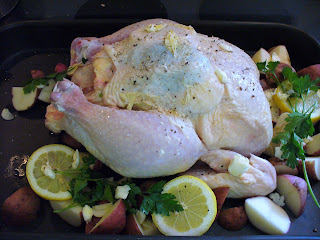
There is nothing like roasted chicken on Sunday afternoon for dinner. It is so easy to roast a chicken. I simply stuffed the cavity with a lemon, cut in half, a big handful of flat-leaf parsley from our garden, salt and pepper. I rubbed the outside of the bird with some butter and sprinkled more salt and pepper on top. I placed some red potatoes around the chicken and topped them with lemon slices, parsley and a little salt and pepper. I popped the bird in the oven and roasted at 375 degrees for about 1 1/2 - 2 hours. The nice thing about Perdue is that their roasters come with pop-up thermometers that let you know when the chicken is done. Otherwise I would use a meat thermometer and roast the whole chicken until it reached an internal temperature of 180 degrees. The thermometer should be placed in the thickest part of the cut of meat without touching the bone, per Perdue's guidelines.

This is my chicken right before it went into the oven...
and unfortunately I forgot to take a shot when it was done roasting and before we dug into it. We devoured quite a bit of the chicken for dinner. I did have enough meat left over to make chicken salad for sandwiches for our lunches for the week. We really look forward to lunch when homemade chicken salad is on the menu.

A disturbing shot of the carcass after my husband cut it up. He loves that job.

I put the chicken bones in the crock pot with a whole onion, chopped into quarters. I didn't have whole carrots, so I threw a handful of baby carrots in the pot. I also added a whole head of garlic sliced in half, a few of the lemon slices from the roasting pan, a couple of celery stalks with leaves, cut into big chunks, a couple of bay leaves, a large handful of parsley sprigs, a few grinds of pepper and about a Tablespoon of salt. I didn't add too much salt, because I salted the roaster before popping in the oven. I filled the crock pot with water and turned it on LOW and left it on overnight.

The next morning when I came downstairs, my kitchen smelled so good and this is what I found. Sorry for the yellow glare.

Next I strained the stock through a sieve and pressed the ingredients down with a spoon to get as much flavor as I could into the finished stock.


Liquid gold...I let the stock cool down and then I put it in the refrigerator until the next day. At that point, I skimmed some of the fat off and put into freezer containers and into the freezer for future use. I use containers of different sizes: 32 oz, 16 oz and 1 cup.

This bowl is 4.5 quarts. I estimate that I made about 4 quarts as this bowl is not all of the way full with chicken stock. I priced store-brand chicken stock at .50 for a 14.5 oz can and brand name stock costing up to a dollar. Four quarts = 128 oz, so I made almost 9 full cans of stock and saved at least $4.50. I didn't take into consideration all of the ingredients that went into roasting the chicken and making the stock. I had everything already on hand except for the lemons. $4.50 may not seem like a lot of savings, but I will do this through out the fall and winter, because we use a lot of stock during those seasons. And the flavor of store bought just doesn't compare to homemade.


Making your own chicken stock is very easy and really stretches your grocery dollar. Things to remember when making your chicken stock:

  • Look for sales on roasting chickens and figure out your "buy" price. In my area, .79/lb is a good price.
  • Find a recipe for roasting chicken that you like because those flavors will carry into your stock.
  • There are tons of stock recipes online, but I use simple vegetables that usually can be found on sale and in my refrigerator.

Do you make your own homemade chicken stock?

Thanks for reading FamilyBalanceSheet. If you don't already receive FBS free updates, please click here to sign up.

This post is linked to:

photos: familybalancesheet.org

Wednesday, July 15, 2009

Grocery essentials: Do you have a "buy" price?

Do you pay attention to the price per unit when shopping for groceries? Do you have a price book or list that you keep with you to track your "buy" prices? The price you are willing to purchase a product at because you know it is at it's lowest price. I am always intrigued when I occasionally see someone in a grocery store with a binder that looks like a price book. I am usually overwhelmed with my coupon organizer, shopping list and 2 restless kids to consider toting an additional book.

There is only one item that I diligently track the per unit price of and that is diapers. I still have one child in diapers and we have gone the disposable route. I did cloth diapers when both of my girls were infants. I was given a set of infant cloth diapers as a gift, but when they outgrew the cloth I switched to disposable.

To save myself time and money, I have found that buying Luvs diapers at BJ's (a warehouse club) has been the cheapest for me. I tried BJ's brand diapers and I did not like them. I liked the price, but did not like the diaper. They smelled terribly of plastic and they bunched up. So I stick with Luvs, because they are cheaper than Pampers or Huggies and BJ's usually offers a $5.00 coupon off of a box. That brings the price down to $24.99 a box and my baby wears size 4. With 180 diapers in a size 4 box that makes the price per unit of .139 per diaper. I use that price as my gauge and if I find them cheaper elsewhere I will buy, but BJ's is where I usually shop for diapers. That box will last me a little over a month.

I was thrilled when I read at Common Sense with Money about a Huggies diaper deal at Rite-Aid. I followed her instructions and I bought 5 packages of Huggies for a total of 150 diapers and a price of $57.45. I used 5/$1.50 Huggies coupons. I made 2 separate purchases and used a $5/$25 purchase coupon on each purchase. That brought my out-of-pocket expense to $39.95, but through Rite-Aid's Single Check Rebate program, I earned a $25 gift card for Rite-Aid and a FREE voucher for a package of Huggies diapers.

My final per-unit price will be .08 per diaper. I was thrilled.

Outside of diapers, I don't really track the per unit price of other grocery items. When shopping, I will look at the best price per unit on the items that I need on that particular trip, but I don't keep a price book. There are other items where I think a price book would be helpful, like coffee, toilet paper, chicken, turkey or cereal, to name just a few. These are constantly on my shopping list, so figuring out a "buy" price would help me know when I find a sale if it is a good time to stock up.

I have been working hard trying to reduce our grocery expense. Instead of a binder or book, I am going to write my "buy" price for our main grocery staples or essentials on a 3 X 5 card and keep it in my coupon file. I won't feel so overwhelmed and I think it will help me save some money by knowing when to stock up.


Do you track the price per unit when buying your groceries? Do you have a price book to manage your "buy" prices?

Thanks for reading FamilyBalanceSheet. If you don't already receive FBS free updates, please click here to sign up.


Wednesday, April 29, 2009

Today's trip to CVS - This is what 22 cents looks like.


I stopped by CVS today to check out their sales and I found some great clearance deals over in the deodorant aisle. The Dry Idea deodorant in the photo was marked down to $1.00 and I had two $1.00/1 coupons in my new coupon organizer. The Suave deodorant in the photo was marked down to .60 and I had one $1.00/2 coupon. I also had a coupon for free gum. The bottom of the receipt stated that I saved $13.75 today, but today this is what 22 cents looks like!


Did you like this article? Click here to sign up for free updates.

Tuesday, April 28, 2009

Finally, I found a coupon organizer that I like!

I have been looking for a coupon organizer that I like and that fits my coupon use for a long time. I was using a small plastic box for years, but it was hard to manage and it didn't fit in my handbag. When it broke recently after it fell on the floor, I set out on a mission to find an organizer that I really like and find useful.

I use enough coupons that I need an organizer, but I am not at the level where I need a big binder. As I was strolling through Wal-mart, I found an organizer that I really like. It is flat so it fits in my purse and I can now keep it with me at all times. It only has 13 tabs, but I consolidated my tabs and it is working out for me. There is a back pocket where I keep my Wegmans coupon book and my CVS bucks.


I never thought I would be so excited over a coupon organizer...I really need to get out more!

Please subscribe! Click here.

Wednesday, February 18, 2009

Is your child a foodie? If not, consider menu planning.

"Do you cook every night?" my good friend recently asked me this as she was scooping some boxed macaroni & cheese lunch for our hungry kids. We were having a play-date, but honestly it is as much a play-date for the mommies as it is for the kiddies. Anyway... my friend is a recent sahm and she thought with her new arrangement she would be cooking more, but she continued to say, "I am a short-order cook". She complained that her kids are so picky and they only eat a few things.

To be honest, it is because of my friend that I have been so diligent in not becoming a short order cook. When I was pregnant years ago with my oldest, I was having dinner at this friend's house and her hubby made an amazing dinner. He is a great cook. He loves to experiment for dinner guests and was trying a new recipe on us. But their oldest would not try it, not even a bite. They didn't push the issue instead they made her a Nutella sandwich. You read that right...NUTELLA sandwich. I was horrified and vowed quietly that that would not happen in my house...

Three years later I can honestly say it hasn't. Maybe it is just her personality, but my 3 year old eats whatever I put on her plate and always has. Asparagus...devours it...kale...more please...and on and on. I will admit pasta is her favorite food and she would become a noodle if she could, but there isn't a green veggie that she won't eat. I introduced foods to her slowly about 6 months of age. We used a few jars, but mostly we made our own baby food. We started with mashed bananas and sweet potatoes and by a year she was eating pretty much what I made for dinner except it was pureed.

Enter Menu Planning.
When dd was born my husband and I decided that I would stay at home. Prior to her birth , we ate out quite a bit, because we were both working long hours and neither of us would feel like cooking. Going to one salary kicked our restaurant habit out the window and I needed to cook more often. I always loved to cook and now I had more time at home to do so. I also like to try new recipes, mostly from Cooking Light magazine or the Food Network. I started planning our menu around simple yet yummy recipes from these sources. I like to use fresh ingredients and we are members of CSA which provides us with seasonal ingredients that I might not normally buy. Over the years I have relied on a handful of recipes that are now my go-to meals. I know my family likes them and they are simple, easy and time-saving.

Over the last few months I have become even more diligent with my menu-planning. When I was running to the grocery store several times a week to pick up dinner ingredients, I said ENOUGH, and found myself a calendar and I began to map out our meals. I also refer to the grocery ads, but I mostly refer to my binder of the recipes that we love.

I like to think that my dd is a 3 year old foodie. I also like to think that my menu-planning helped create her love of food.

Has menu-planning helped your family in ways other than saving you money?

Wednesday, February 4, 2009

Spring must be around the corner - I got my CSA registration!!

It is frigid outside and that darn groundhog saw his shadow on Monday so now we have 6 more long weeks of winter...but I received an email yesterday that gives me hope that spring isn't too far away.

I received my registration form for our local CSA. CSA stands for "community supported agriculture". Our CSA happens to be certified organic and this is how we are able to afford to eat as much organic produce as we do. A CSA is when community members pay a local farmer an annual fee to cover the farm's production costs. In return members receive a weekly "share" of fresh, local, in season produce. Wikipedia's description describes it in further detail.


Our CSA share lasts 28 weeks from May thru November; it usually ends right before Thanksgiving. We purchase a half share which is usually enough produce to last us a week or less, but for us the whole share would be too much. With our CSA, if we prepay by April 1st, our payment is $374 for 28 weeks or $13.36 of organic produce a week. You have to break down the weekly payment to really understand the savings. There is no way I could buy this much organic produce at a grocery store for $13.36 a week. The weekly share follows the local harvest schedule which is posted on our CSA's website. June is one of my favorite months because we get strawberries and if you have never had a local organic strawberry - it is heaven. August and September are BIG months with loads of tomatoes, peppers, onions and summer squashes. I also look forward to fall with the winter squashes, sweet potatoes and kale - yummy!!


Another plus about a CSA is that my family is learning to eat and love veggies that I never would have thought to buy, like kale, swiss chard, and collard greens. This will be our sixth year with our CSA and I had never eaten those three greens before we were members.


While there are still costs with the CSA, I just don't have the yard space or time to garden where I would harvest this much produce. I do have a small garden where I grow a couple of extra tomato plants and peppers for freezing. In another month or so I am going to start to plan out my little garden spot.


Another perk of our CSA is that they have occasional "you pick" days on their farm. They are usually on Saturdays and it gives us extra produce at no additional cost. Our farm also has a potluck picnic sometime during the year and last year at the picnic they gave out extra produce again at no additional cost. I think I came home with at least 3 weeks worth of extra produce such as peppers, carrots, onions, and winter squashes. I promptly cleaned and chopped it up and put it in the freezer.


Is eating organic important to you? Are you members of a local CSA?