Showing posts with label Financial Organization. Show all posts

Thursday, January 3, 2013

Christmas Spending Budget for 2013 {FREE Excel Spreadsheet Offer}


Yesterday, I announced my new year long series, Christmas Savings Club. To kick off the series and get everyone started on the first step, I created a Christmas Gift & Spending Budget excel spreadsheet that I am offering FREE to readers. Details on how to obtain your FREE copy will be at the bottom of this post.

Our goal with the Christmas Savings Club is to save enough cash to achieve a Cash Christmas in 2013. Too many people rely on credit cards to carry them through the holiday spending and January ends up being a very stressful month when those credit card bills start rolling in.

Before the first meeting on the 25th, everyone needs to create a Christmas Gift & Spending Budget for 2013. On the budget, list all of your Christmas spending from 2012, include gifts, decorations, cards, stamps, parties, etc. Next, fill in a budget for 2013. This can be a working budget, where you make modifications through out the year, but you need a place to start.

A view of my FREE spreadsheet:


After you fill in your 2013 budget, divide that total number by 11 and that is the amount that you need to save each month between now and November.

I'm offering the excel spreadsheet FREE to my readers. All you need to do is email me your request at: familybalancesheet @ gmail (dot) com.

January's Christmas Savings Club Goal: Create your budget, divide by 11 and save your first month's goal. Stop back on the 25th and let us know how you did.

Thanks for reading. If you would like to receive FREE updates of FBS, there are four ways to do so:
Follow Me on Pinterest

Thursday, July 19, 2012

Donating Household Clutter and Taking a Tax Deduction


Every year, I have a yard sale. It usually coincides with our neighborhood's big sale and I make out quite nicely with the profits. However, this year we were in Pittsburgh and I missed out on the event...and the cash.

So instead, I hauled our stuff to the Salvation Army. I've been tackling clutter since January and I had the boxes stacked in my garage to prove it. While I love the instant cash that you can get from a yard sale, this year a tax deduction will have to do.

It's been awhile since I've taken a tax deduction over having a yard sale, so I did a little research. Unfortunately not everything in your home is considered a tax deduction if donated. The queen sized comforter that I no longer used can be deducted, but the kids' outgrown mega block set cannot.

There are rules to follow when taking a tax deduction for your donated items. According to the IRS Publication 526, "if you give property to a qualified organization, you generally can deduct the fair market value of the property at the time of the contribution."

Clothing and certain household items can be deducted as long as they are in "good used condition or better." Household items that can be deducted if donated are furniture and furnishings, electronics, appliances, linens, and other similar items. Household items NOT included would be food, paintings, antiques, other objects of art, jewelry, gems, and collections.

(There is one exception to that rule: "You can take a deduction for a contribution of an item of clothing or a household item that is not in good used condition or better if you deduct more than $500 for it and include a qualified appraisal of it with your return.")

As described by the IRS, "fair market value is the price at which property would change hands between a willing buyer and a willing seller, neither having to buy or sell, and both having reasonable knowledge of all the relevant facts."

"The fair market value of used clothing and other personal items is usually far less than the price you paid for them. There are no fixed formulas or methods for finding the value of items of clothing. You should claim as the value the price that buyers of used items actually pay in used clothing stores, such as consignment or thrift shops."

Household items. "The fair market value of used household items, such as furniture, appliances, and linens, is usually much lower than the price paid when new. These items may have little or no market value because they are in a worn condition, out of style, or no longer useful. For these reasons, formulas (such as using a percentage of the cost to buy a new replacement item) are not acceptable in determining value. "

"You should support your valuation with photographs, canceled checks, receipts from your purchase of the items, or other evidence. Magazine or newspaper articles and photographs that describe the items and statements by the recipients of the items are also useful. Do not include any of this evidence with your tax return." Keep it with your tax documents.

My experience: The Salvation Army gave me a dated blank receipt for the donated goods. There is space for me to write down all of the items that are deductible. They also include a valuation guide for items donated to the Salvation Army. It is a lengthy, descriptive list of clothing and furniture items with price ranges from low value to high value, depending on the item's condition. For example, a ladies' blouse has a $2 low value up to $7.50 high value. I looked at every item that I was donating and determined what condition it was in. Most of our clothing was in fairly good condition, so I used a middle range. My deduction tally for this haul was $115.

Do you sell your household clutter or take a tax deduction? Let us know about your experience in the comments.

Remember, I am not a tax professional, please refer to the IRS Publication 526 or your tax professional for more information.
Thanks for reading. If you would like to receive FREE updates of FBS, there are four ways to do so:
Follow Me on Pinterest

Wednesday, April 11, 2012

How Do You Organize Paperwork, Both Online and Off?


Today, I'm answering a question posed to me by BlogHer's Life Well Lived Campaign, "how do you organize paperwork, both online and off?"

I have written before about how I organize our offline paperwork:

2012 is the year that my husband and I are trying to go more paperless with our personal and business paperwork.

Currently, at our business I have started to scan more documents and save them on the computer. After I scan, I shred the documents. That was a huge step for me and something I never thought I would do, but honestly we're running out of room to store all of our office paper work. In the business that we are in, there are laws on how long we need to keep documentation. Our lack of space has pushed us to start scanning and shredding.

At home, it is another story. I have yet to purchase a scanner for my home office, but my husband is pushing me in that direction. However, I have stopped printing receipts that I receive online and instead I have created folders in my email account to file the receipts.

Baby steps...

How do you organize paperwork, both online and off? Let us know your tips and tricks in the comments.

Also, hop on over to Life Well Lived and read, Ten Ways to Organize Your Papers - Offline and Online. While you are there, enter the current Life Well Lived Moments Sweepstakes for a chance to win an iPod Touch and a $50 iTunes gift certificate.

Thanks for reading. If you would like to receive FREE updates of FBS, there are four ways to do so:
Follow Me on Pinterest

Tuesday, March 6, 2012

Marriage and Money: 5 Tips To Reduce the Money Arguments

I'm participating in Women’s Money Week which is about encouraging women to speak up about money, take control of our finances, and reshape our financial future. Women’s Money Week will run from March 5th-11th, 2012 on WomensMoneyWeek.com — coinciding with International Women’s Day.  Today's topic is Money and Relationships.


My husband and I do not have a perfect marriage, but we are perfect for one another. After almost 12 years of marriage and 9 years of dating (long story), I still have the hots for him. We have an occasional squabble here and there, but I'll be very honest and upfront with you, we do not argue about money. Although, it wasn't always that way.

Money tension is one of the leading causes of divorce. It could be from the stress of unemployment, a large debt load, or the amount of shoes in someone's closet; money can be an evil force in a marriage. My husband and I have worked through our differences about money over the last 12 years. For this reason, I have put together a list of tips that contribute to my marriage's current lack of money tension. Whether you are in a marriage that is struggling over money issues or not, I hope you find them helpful.

5 Tips to Help You Reduce the Money Arguments in Your Marriage


1. Designate a Family Office Manager
In my house, it's me. No surprise there; I write a blog about family finances. But I also want to be the Family Office Manager (FOM). It should be the spouse who has the most interest and drive to perform the tasks. The Family Office Manager might track spending, reconcile and manage the accounts, pay the bills on time, and update the Family Balance Sheet. The tasks will vary between households, so devise a to-do list of your family's financial tasks, so that the FOM knows what is expected of them.

The FOM might manage the money, but shouldn't be considered the controller of the money. That is a joint responsibility between the two spouses (at least in our home). My husband and I have equal footing when it comes to money decisions, even though my husband is currently the primary income earner. In some ways, I think the fact that I am the FOM and he is the primary income earner helps balance out any feelings of inequity. 

2. Complete a Family Balance Sheet on a Monthly Basis
It is not always easy to communicate your current financial snapshot with your spouse, so let the balance sheet do the talking for you. I developed this spreadsheet years ago, as a way to communicate our finances with my husband. It's all there in black and white; there's no denying it or running from it. The offer of a free spreadsheet is still available, just head over the the Family Balance Sheet page for more details.

3. Make Clear Financial Goals {Together}
Take some time to discuss your family and marriage's financial goals. I have found that there is less tension when we are both on the same page with our goals, but you need to take the time to discuss those goals together.  Do you want to eliminate your credit card debt? Or buy a home? Or save money for a trip to Walt Disney World?  Be realistic, but dream a little too. Write down your goals and make them visible. There is space at the bottom of the Family Balance Sheet for your financial goals.

4. Meet Regularly to Discuss Finances
Check in regularly with one another to discuss any upcoming expenses, cash flow, and goal updates. This will keep you on the same page and marching in the same direction. Meeting regularly could be every Sunday night or every pay day, whatever fits your schedule.

If possible, make it a  kid-free meeting. For us, it's not always possible to find some child free time on the weekends and when the kids finally get to bed at night, we're usually in a brain fog from a long day at work. Our kids sense that mommy and daddy are having a serious conversation and quite suddenly they want to sit on our laps, need a snack from a high shelf, or have a very important secret to whisper in our ears. Basically, they want our attention and don't like the fact that they aren't getting it. One solution we have found is to set them up with a movie and a special snack, like popcorn. That usually gives us enough time to meet. In other words, you might need to be creative to carve out the time to meet regularly.

  Four Rules for Your Money Meetings:
  • Make a promise to not raise voices.
  • Be honest with each other about the state of your financial affairs.
  • Own up to any financial indiscretions.
  • Work through disagreements civilly and move forward.
5. Consider an Adult Allowance
We started an adult allowance a few years ago when I noticed that I, as the FOM, was getting frustrated by our discretionary spending. We have a budget for items like clothes, hair cuts, and miscellany, but I felt like I was getting blind sided by some purchases and my husband felt like I was watching his spending like a hawk. I didn't like the feeling of being a mother hen and I knew he wanted a little breathing room.

The solution: we each opened up a debit account for our own personal spending. The accounts are to cover the personal categories that caused the most tension, such as clothes, hobbies, haircuts, and other miscellany. We came up with a figure that fit into our budget and on the first of every month that money is transferred into our individual accounts. Now if there is a personal purchase that we would like to make, it is up to us, individually, to save the money, manage the money, and budget the money. No questions are asked, it is our own personal stash. That alone has alleviated most of the tension in our money discussions.


I am not a therapist, but I am a wife who wants love to be the center of my marriage, not money and the incendiary arguments that it can cause. Money is necessary, but it doesn't have to be evil. It will only cause tension if you let it.

Does money cause tension in your marriage? How have you worked through money issues in your marriage? Please let us know in the comments.

Thanks for reading. If you would like to receive FREE updates of FBS, there are four ways to do so:
Follow Me on Pinterest

This post is part of Women's Money Week 2012. For more posts about Relationships and Money see Relationships and Money Roundup

Tuesday, January 24, 2012

3 Simple Office Supplies for Smooth Tax Prep


We have our 2011 tax meeting this week with our accountant. We own an S corporation and have a few employees, so we have a CPA prepare our taxes every year. Honestly, he is worth his weight in gold; the tax rules make my head spin. I'm in close contact with their office through out the year, so there are never any surprises at tax time.

In all honesty, tax season goes fairly smoothly for us. I keep our paper work organized and QuickBooksupdated through out the year, so that when January rolls around, I only need to pull together the year end statements as they arrive in the mail.

Three simple office supplies keep our paperwork organized...and really it isn't rocket science. My desk might look like a mess (occasionally), but I do keep important financial paperwork organized.

3 Simple Office Supplies

1.A 4.5 inch binder


For our small business, I file large receipts, bills, and statements in a large 4.5 inch binder. I use tabs to separate our expense categories. Everything is filed immediately after I enter the transaction into our QuickBooks software, so I don't get behind.

Our accountant doesn't need to see this binder, but it contains all of the receipts that back up our business deductions, so I'll store it away in a closet with other past years. The size that you need would depend on the amount of receipts and statements that you receive through out the year. This size seems to hold everything for me for the year and my husband grabs them when they are on sale through out the year at office supply stores.

2. 13 pocket, Expandable Receipt File


Our smaller sized receipts get filed in a 13 pocket, expandable file. I file them by month and all receipts get filed as soon as the transaction is entered into QuickBooks. Again, my accountant does not need to see these receipts when preparing our taxes, but they do support our tax deductions, so I store them with the binders.

3. File Folder


I told you...not rocket science...

For our personal tax returns, I keep an ongoing "Taxes" file for any paper work that we need to support our tax deductions, such charity receipts, Goodwill donations receipts, real estate and school tax statements, year-end statements for mortgage interest, student loan interest, interest-bearing checking and savings accounts. As I receive the paper work through out the year, it is filed, so that at tax time everything is in one place. I do pass this folder along to my accountant for his review. All of that paperwork is then filed with our tax returns.

Do you have questions on how long to keep your financial paperwork? Read How Long Should I Keep My Financial Documents.

Are you prepared for tax season? How do you keep your financial paperwork organized for your taxes?

This post is linked to Frugal Friday at Life as MOM.

Thanks for reading. If you would like to receive FREE updates of FBS, there are four ways to do so:

Follow Me on Pinterest

Disclosure - This post contains affiliate links that help support this site at no additional cost to you. Thank you for supporting Family Balance Sheet! You can read the site's full disclosure here.

This is a personal blog about my thoughts, experiences and ideas on personal finance and home mangagement. The contents of this site are for informational purposes only. I am not a financial professional, just a wife and mom who happens to enjoy topics on personal finance and home management. Please consult a professional if you feel you are in need of professional advice.

Wednesday, January 18, 2012

7 Steps to an Organized Pantry | Kitchen Economics

I'm on a roll. I cleaned off my desk and reorganized our home office. Now I'm going through our kitchen cupboards--all in an attempt to make my life easier. How can a girl make a grocery list when her cupboards look like this mess?


I don't keep a large stockpile, because of my lack of storage space. We don't have a pantry closet, so I use several cupboards in my kitchen for food storage and some shelves in my garage for any overflow. Because of my lack of space, I am more of a ‘shop as I need’ kind of person and I use the sales flyers to plan a week’s menu.

When my cupboards are in disarray, I wind up with duplicates, out of date food, and wasted time. No matter how big or small your pantry is, these steps will help you organize it to be more functional and less frustrating.

7 Simple Steps to an Organized Pantry

1. Remove everything from the cupboards and clean the shelves with a damp cloth and dry.


2. Sort food items by category, such as baking items, breakfast, canned goods, coffee/tea, condiments, pasta/rice, snacks, etc.


3. Place your foods near the spot where they are used. Where do you use each category? All of my spices and herbs are in a cupboard next to my stove. All of the cooking oils and vinegars are above my stove. My coffee is stored right by the machine and all of my baking supplies are stored right above the counter where I use my mixer.

4. Face the food labels forward for easy viewing.

5. Alphabetize your herbs and spices.

6. Donate any food that you probably won’t eat and is not outdated to a food bank.

7. Discard any outdated food. I found this bottle of Ground Cayenne Pepper with a August 2000 date on it. That was 2 months before I got married and I was not much of a cook back then, so I'm not quite sure what I was doing with a bottle of Cayenne. I guess it has been some time since I weeded out my spices. I ended up throwing 7 bottles of out-dated spices away...OUCH!


A clean and organized pantry will make menu planning easier for me.

I think it is safe to say that I don't need to replace the cayenne.

What does your kitchen pantry or food storage area look like? Does it need a little attention? Let us know in the comments.


Thanks for reading. If you would like to receive FREE updates of FBS, there are four ways to do so:

Follow Me on Pinterest

Thursday, January 12, 2012

Resolve to Organize Your Home Office

Have you been busy this week?

Yesterday, we cleaned off our desks. I don't know about you, but I feel so much better now that my desk is clear.


We also resolved to regularly discuss our finances with our spouse. I'm reconciling our accounts and updating our Family Balance Sheet to prepare for the meeting with my husband. Have you scheduled your meeting yet? My offer of a FREE Family Balance Sheet spreadsheet is always open when you are ready. Just go to the "free FBS template" tab at the top of the page for more information.

Today's resolution: Organize Your Home Office.

Now that the desk top is clear, the files, piles, bills, statements, and receipts also need to be sorted and organized. Some things to read and implement:


We have not yet taken the leap to go paperless in our home office, but our accountant is giving us some ideas and assuring me that it is possible. As I go through the process, I will report our progress back to you.

What tips do you have for organizing your home office? Let us know in the comments.

Thanks for reading. If you would like to receive FREE updates of FBS, there are four ways to do so:

Follow Me on Pinterest

Wednesday, January 11, 2012

Resolve to Clean Off Your Desk

Last week, I gave you a snapshot of my messy desk in my Keeping It Real post. It was quite a sight.


But I am happy to report that I sorted through the piles, tossed any non-necessities, stored away my kids' artwork and some Christmas decorations, filed some financial documents, found a new home for some puzzles, and cleared the way for fresh thinking and productivity.


Commenter, KrantCents, wrote "if my desk is messy it affects my thinking." I totally agree. If I want to nail my 2012 goals, then I need a clean space to think, create, and execute.

What does your desk look like? Take a moment (or two) and clean it off. Let us know in the comments how good you felt afterwards.

Thanks for reading. If you would like to receive FREE updates of FBS, there are four ways to do so:

Follow Me on Pinterest

Tuesday, January 10, 2012

Resolve to Regularly Discuss Your Finances with Your Spouse


The following post is as much a reminder for me as it is for everyone else.

Life happened this weekend. A sunny day in the middle of January called us outdoors. A movie night and popcorn enjoyed with the kiddos. Sunday lunch spent with extended family. And a fierce and entertaining football game between the Pittsburgh Steelers and the Denver Broncos beckoned us to the TV. It was a great weekend, except for one thing: my husband and I didn't have a much needed money talk.

When my husband and I are focused on our goals, we nail them. We have proven it to ourselves many times in the past. But for the two of us to achieve our financial goals, we need to have money conversations and they need to be done regularly.

Money conversations aren't always easy to have, yet I feel that for me and my husband they are so imperative to the stability of our marriage and our home. I created our Family Balance Sheet years ago as a way for me to communicate the state of our finances to my husband. There are no surprises. What we have and what we owe is always right there in black and white...every month.


The first section recaps our assets and liabilities. The Asset portion is column B - D, and the Liabilities portion is E - H.

  • Column A = Name of Account
  • Column B = Balance
  • Column C = Target Balance
  • Column D = Difference between the target balance and the actual balance. How much do we need to save to get to our target.
  • Column E = Monthly debt payment
  • Column F = Loan balance
  • Column G = final due date of the loan
  • Column H = Interest rate or finance charge
  • Column I = Statement date where I got the balances

The second section is for what I call petty cash.

The third section is for our 2012 Financial Goals. How much do we want to reduce debt by? Do we need to replenish our emergency savings? What home improvements need to be done? Every home has different short-term financial goals.

The fourth section is for long-term financial goals, trips we would like to take, retirement aspirations, anything in the 2 year and beyond category.

To any interested readers: I will send you a FREE attachment of the Excel spreadsheet for you to create your own Family Balance Sheet. It will be blank, but have the formulas. You will be able to add additional rows if needed.

Please email me at familybalancesheet at gmail dot com and I will email you the file within 3 business days of your request.

Whether you take advantage of my balance sheet excel sheet or you use your own spreadsheet, I encourage you to meet regularly with your spouse to discuss your finances. Our next discussion is now on our calendar.

Did you make a 2012 goal to meet regularly with your spouse to discuss finances? Tell us about it in the comments.

Thanks for reading. If you would like to receive FREE updates of FBS, there are four ways to do so:

Follow Me on Pinterest

Image: tungphoto / FreeDigitalPhotos.net

Tuesday, January 3, 2012

2012 Financial Goals


On Christmas day, my husband and I spent 4 hours together traveling in a car to visit his family. The kids were in the back seat watching a movie and we were in the front seat reviewing 2011 and strategizing for the upcoming year. Four hours of uninterrupted time is a luxury, so we took advantage of it. We talked through some issues and opportunities for our business and our personal, family, and financial goals.

We are still working through some numbers and there might be some adjustments in the timelines we have given ourselves, but these are our financial priorities for 2012.

Our 2012 Financial Goals

1. Finish Will.
No more excuses. Just get it done!

2. Increase our Monthly Debt Payment.
We have set a goal date of July 2015 to pay off all of our debt. This includes our mortgage and my husband's student loan. We are very excited about the possibility of being completely debt-free and there are two things that have made it a possibility: (1) We made a very conscious decision 10 years ago to buy a house below our means and (2) we made a risky decision 18 months ago to convert our mortgage to a HELOC.

3. Increase Family Emergency Fund to Six Months Salary.
Currently, we have about 3 months salary saved, but we are self-employed and should have a six month security net. This might take us 2 years to achieve.

4. Start a Car Replacement Savings Account.
Our 2002 Honda Civic has 125,000 miles and still runs well, but we don't want to have to take out a loan when it is time to replace the vehicle. The amount needed is yet to be determined.

5. Start College Savings Accounts for our Girls.
Our oldest daughter is in Kindergarten and we have not started to save for her higher education. My husband and I have some ideas about how much we want to contribute and we definitely need to devise a game plan this year. Do we set up 529 accounts or other types of accounts? I need to do some research on this one. Our first decision is how much do we want to save for each of the girls and then we'll go from there.

6. Save for a Walt Disney World Vacation
We want to go to Walt Disney World in the fall of 2012 or spring of 2013. I have never been there and neither has my husband so we have no idea what to expect or even how to plan. I'm not even sure how much we will need to save. I'll be asking you for advice in the upcoming weeks.

7. Review our Retirement.
Retirement saving has been a permanent part of our monthly budget for the entire eleven years that we have been married and this will not change. But we do need to review it more regularly to make sure we are on track to retire...eventually.

These goals are epic for us. They seem insurmountable to me as I stare at them, but they are important to my family's well-being. These goals will not be achieved by just reducing our spending; we will have to increase our income as well. The good news about making this list is that it has given me many blog post ideas for 2012! The bad news is that we have a lot of work to do.

What financial goals did you make for 2012? Let us know in the comments.

Thanks for reading. If you would like to receive FREE updates of FBS, there are four ways to do so:

Follow Me on Pinterest

Image: Grant Cochrane / FreeDigitalPhotos.net

Wednesday, August 17, 2011

How Long Should You Keep Financial Documents


Are your financial documents piled up in the corner of your office or under your desk? A few years ago, I was just filing papers in my cabinet, but not purging along the way. It got to the point where I couldn't close the drawers of my filing cabinet, so I took some time to weed them out.

As I was removing the files, I wondered, What Financial Records Should I Keep and How Long Should I Keep Them For? So much is done electronically now, but there are documents where a paper copy is needed. So, I googled my question and here is what I found.

Bank Statements - One nice thing (among many) about the electronic age is that banks keep statements online up to a couple of years. Our personal bank has statements online all the way back to 2006. However, you should print any canceled checks or year-end statements that you would need for tax purposes, ie - charitable contributions, home improvements, business expenses, mortgage payments, etc. If you are not going to print the statements, you really need to check them each month for errors and fees.

Bills - Utility bills can be tossed the following month when you receive your next statement and it shows that the bill was paid, unless you need the bill for tax deduction purposes, then refer to Taxes below. Any bills for big purchases like jewelry, appliances, computers, etc, should be kept permanently for insurance and warranty purposes. Permanent home improvement bills should also be kept while you still own your home.

Credit Card Statements - These can also be found online, so I'm not sure a paper copy is necessary, unless you need it for documentation for tax deductions, then see Taxes below. If you are not printing it, you should still review it closely for any discrepancies and unnecessary or incorrect fees. You should keep any credit card receipts to match up with your statement. Read more about receipts below.

Household Records - Keep all records from the purchase of your home and any receipts for permanent home improvements and selling expenses for as long as you own your home. This is very important and something that I learned while researching for this post. When you go to sell your home, the cost of permanent home improvements and any selling expenses incurred will be added to the original purchase price of your home. This final number will help to lower your capital gains tax.

Legal documents, such as wills, passports, birth certificates, marriage license, proof of paid mortgage, deed to your home, title to your vehicles should be kept permanently in a safe location such as a safe or safety deposit box.

Pay Stubs - Keep for the year until you get your annual W-2. If the information matches, you can shred your pay stubs. If the information doesn't match, head to your human resource department for correction.

Receipts - Keep until the warranty expires or you can no longer return the item. Any receipt that supports a tax deduction, should be kept with your tax returns. For other receipts from a credit card for example, groceries or gas, keep until you get your next statement to look for any errors.

Retirement/ Savings/Brokerage Statements -
  • Keep records permanently for nondeductible contributions to an IRA to prove that you already paid taxes on this money when it is time to withdrawal.
  • Keep the quarterly statements for your 401k or other IRA accounts until you receive the annual statement. Check for any discrepancies. If there aren't any, shred the quarterly statements, but keep the yearly until you retire or close the account.
  • Keep any brokerage statements until you sell the security. You'll need proof of gains or losses at tax time.
Taxes - You can be audited by the IRS for up to three years after you file your return. BUT if the IRS has reason to suspect that you under reported your gross income by 25% or more, the IRS has up to six years to audit your return. AND if you fail to file or they suspect a fraudulent return, there is not time limit on the possibility of an audit. ALSO, if you are self-employed, you should keep your returns and supporting documents for six years.
It is important to note that you should keep your returns and any supporting documents for these time periods. Supporting documents include any receipts, statements or canceled checks that support income or a tax deduction that you took.
Here is a link to IRS.gov where it explains their Period of Limitations for tax returns.
Personally, I know we have filed honest returns, but because we are self-employed, I am holding on to our returns indefinitely. I have our returns and all supporting documents neatly filed in the cabinet. How long have you held on to your tax returns?
Some Ideas For Keeping Your Financial Records Organized:
  1. For our personal taxes, we keep a present year file for tax deduction documents, such as receipts for charitable contributions, mortgage tax payments, receipts for school and real estate taxes, Goodwill donations, etc. As we receive them, they are put into the file and at the end of the year, I have everything in one place.
  2. Every year for our small business, I create a 4 inch binder, with tabs for each of our expense categories, to store the statements, receipts and invoices. I use a small accordion file with 12 monthly files for credit card receipts.
  3. In your filing cabinet, group your major files together by category with sub-files. Some examples:
  • Assets - with sub-files like your checking, savings, retirement, etc.
  • Insurance - sub-files would be Auto, Health, Home-Owners, Life, etc.
  • Liabilities - sub-files would be Auto Loan, Credit Card, Mortgage, Student Loan, etc.
  • Home improvements -with sub-files for each major improvement.
  • Medical records should be filed by family member.
  • Professional records with sub-files such as resume, employer records, degree records, etc.
  • Taxes with sub-files for each year.

DO NOT FORGET to shred anything that you are throwing away that has your personal information. This will help you avoid possible identity theft. Shredders can be found just about everywhere and are a worthy, inexpensive investment.

If you have any questions regarding a particular document and feel uneasy about whether or not you need to keep it, then please seek advice from a professional.

Do you have a method for filing your financial records that works well for you? I would love to hear about it. Please let us know in the comments

sources: Suze Orman, Bankrate, IRS.gov

Thanks for reading. If you would like to receive FREE updates of FBS, there are four ways to do so:


Friday, July 15, 2011

Petty Cash


We have an envelope, in an undisclosed location, where we keep cash. It is not an emergency fund or our monthly cash allowance and there isn't a lot of cash in the envelope. Yet it is a place where we can go to if we need a quick $10-$20 for a last minute pizza dinner or the neighbor kids, who are knocking with Girl Scout cookies, or the pick your own strawberry patch or a yard sale outing, the list goes on and on...

The money comes in handy for those sudden occasions and the money usually comes from our yard sales, rebates, or gift money.

My envelope was pretty much empty a few weeks ago, but a recent yard sale helped me replenish it. I feel less stressed now knowing that we have a little bit of cash tucked away.

How do you manage last minute or sudden cash expenses? Do you have a petty cash fund?

Thanks for reading. If you would like to receive FREE updates of FBS, there are four ways to do so:


Image: jscreationzs / FreeDigitalPhotos.net

Friday, July 1, 2011

July 1st ~ Time for A Mid-Year Review


Does it feel like this year is flying by? I don't know about you, but I want summer to slow down a bit so I can savor it. The days might be longer, but they are whizzing by a rapid pass.

Did you make personal, financial or professional goals or plans back in January for 2011? When was the last time you reviewed those lists?

The half way mark of the year is a great time to reflect back on yearly goals and plans to check your progress and make any adjustments, changes or additions.

What goals or projects can you cross off? What goals need to be adjusted or changed? Maybe a goal wasn't clear enough and it really needs to be modified. Did you blow away a particular goal? Push yourself harder and plan your next step.

What new ideas, projects or goals have sprung up over the last 6 months that need to added to your list?

Have you created and updated your Family Balance Sheet? My offer of a FREE spreadsheet is still valid. Get yourself a copy and update it regularly. This will help you track your financial goals.

One of my goals this year is to run a half-marathon. I signed up to run one in October.

This is one goal that I am having the most success with so far. Why? It was a clear, specific goal. It was also a reasonable goal for me. I used to run a lot of 5ks quite a bit before I had kids, but this distance is a new challenge. I found a race and created a training plan for the year. The plan and a blank calendar are posted on my refrigerator to track my workouts. It is in my face every day.

So far, I have been faithful with running 3-4 days a week and have a plan to increase the mileage slowly over the upcoming weeks. I'm sure I'll be a bundle of nerves right before the race, but I feel strongly that I'll be conditioned enough to complete it.

I have some other goals that I haven't been as diligent with and I need to use the following race analogy to finish the year strong in other areas of my life.

Develop a clear, specific, and reasonable plan. Run a half-marathon.

Designate a dead line. Date is set for October 16.

Work backwards to develop a time line and your steps to achieve your goal. I took a blank calendar and counted the weeks backwards from the race date. On Sunday, July 3, I'll have 15 weeks until my race. I am planning my workouts accordingly.

Break it down into steps. Each week, I am looking at my schedule and planning the mileage that I need to achieve.

Keep your plan/goal visible. My race plan is on our refrigerator. I see it every day.

Find an accountability partner. Whether it is a spouse, friend or family member, talk to them about your goal and ask for their encouragement.

Give yourself a reward. I'm thinking after running 13.1 miles, a big banana split will have my name on it.

How are you doing with the plans/goals that you made for yourself or your family back in January? Have you reviewed them lately? Let us know in the comments.

Thanks for reading. If you would like to receive FREE updates of FBS, there are four ways to do so:


Image: renjith krishnan / FreeDigitalPhotos.net

Friday, April 1, 2011

Spring Clean...Your Finances

You spring clean your home; why not spring clean your finances? Welcome in the beauty of the season with 5 Steps to Spring Cleaning Your Finances


  • Review your 2011 Financial Goals. Did you make some financial goals for 2011 back in January? When was the last time you reviewed them. Take some time this month to review your goals. Are you taking the steps to where you want to be? If you didn't make any goals in January, take some time to plan for the balance of the year.


  • Create or update your balance sheet. The Family Balance Sheet is a form that I created to help me communicate the state of our finances with my husband. It is a one page, visual reminder of our assets (checking, savings and retirement accounts), our liabilities (our debts) and our financial goals.


  • Check your credit report for errors or unauthorized activity.. You are entitled to a FREE copy of your credit report. There are three separate credit reporting companies: Equifax, Experian, and TransUnion. You can get a credit report from each of them one time a year. The easiest way to obtain one is to go to www.annualcreditreport.com, a site that joined the three companies together. My husband and I each obtained one report this week and it took about 5 minutes each. In 4 months, we will obtain a another report from a second company and 4 months after that we will obtain a third report. It is recommended to obtain reports from all three because they each might have different information about you. I decided to stagger my requests so that I can monitor through out the year. My husband's report was clean, but I noticed one thing on my report that I am going to investigate. It might not be anything to worry about, but I'm going to look into it anyway.


  • Clean your home office or work space. File, purge, shred and wipe down surfaces to start the second quarter fresh.


  • Organize your financial paperwork. One of my most popular posts is, How Long Should I Keep My Financial Records?. The post reviews what is recommended for bank statements, bills, credit card statements, household records, legal documents, pay stubs, receipts and taxes. If you are having a hard time closing your filing cabinet, then it is time to clean it out.

Have you done any spring cleaning to your finances lately? Are you planning on doing any of the above steps? Let us know in the comments.

Thanks for reading. If you would like to receive FREE updates of FBS, there are four ways to do so:


This post is linked to Frugal Friday at Life as MOM.

Friday, March 25, 2011

Spring Clean...Your Home Office


How can anyone work under that mess?

What does your home office look like right now? As of Wednesday afternoon, my home office looked exactly like the above picture. My piles of papers and receipts were stacked higher than I would like. As soon as I finished the project that was causing much of my mess, I decided that my office needed a good spring clean up. I had let my desk get out of control...once again.

As I was removed everything from the desk, I decided right then if it was trash and needed to be shredded, needed to be filed or put elsewhere, or donated. I also cleaned out the drawers.


I wiped down the desk. I also dusted my monitor with a microfiber cloth. Dust bunnies be gone!


Much better. Don't you feel so much more productive when you are working at a clean desk?

Six Tips to a more Manageable Home Office:

1. Deal with mail immediately. Shred any trash with your name or address on it. Either pay bills immediately or put them in a To-Be-Paid file. If you are getting too many credit card offers, look inside and you should find a phone number to have your name removed from their data base. I don't get any credit card offers anymore.

2. Contain your paper. One of my most popular posts is How Long Should You Keep Financial Records. I spent a snow day last year cleaning out my filing cabinet and it has remained organized ever since. Now if the top of my desk could be so lucky.

3. Invest in a shredder. They are really not that expensive considering that they will help prevent identity theft.

4. Create a visual reminder to help you manage your important to-do list. I am a paper person and keep my to-do list on my desk at all times, but you could easily keep a list on your computer too. This simple reminder has helped me keep track of my monthly and quarterly responsibilities for our business and my home office.

5. Keep your most important papers, projects and financial information organized with a simple binder system.

6. Take a few minutes once a week to clear your desk. Very often, my desk ends up looking like the top picture. This is where I work and it is very hard for me to be productive and focused when papers, books and knick knacks are everywhere. My goal going forward is to clear it off every Friday when I'm done for the week.

Does your home office need a good spring cleaning? Do you have any tips for keeping a clutter-free home office? Let us know in the comments.

Thanks for reading. If you would like to receive FREE updates of FBS, there are four ways to do so:

Wednesday, January 19, 2011

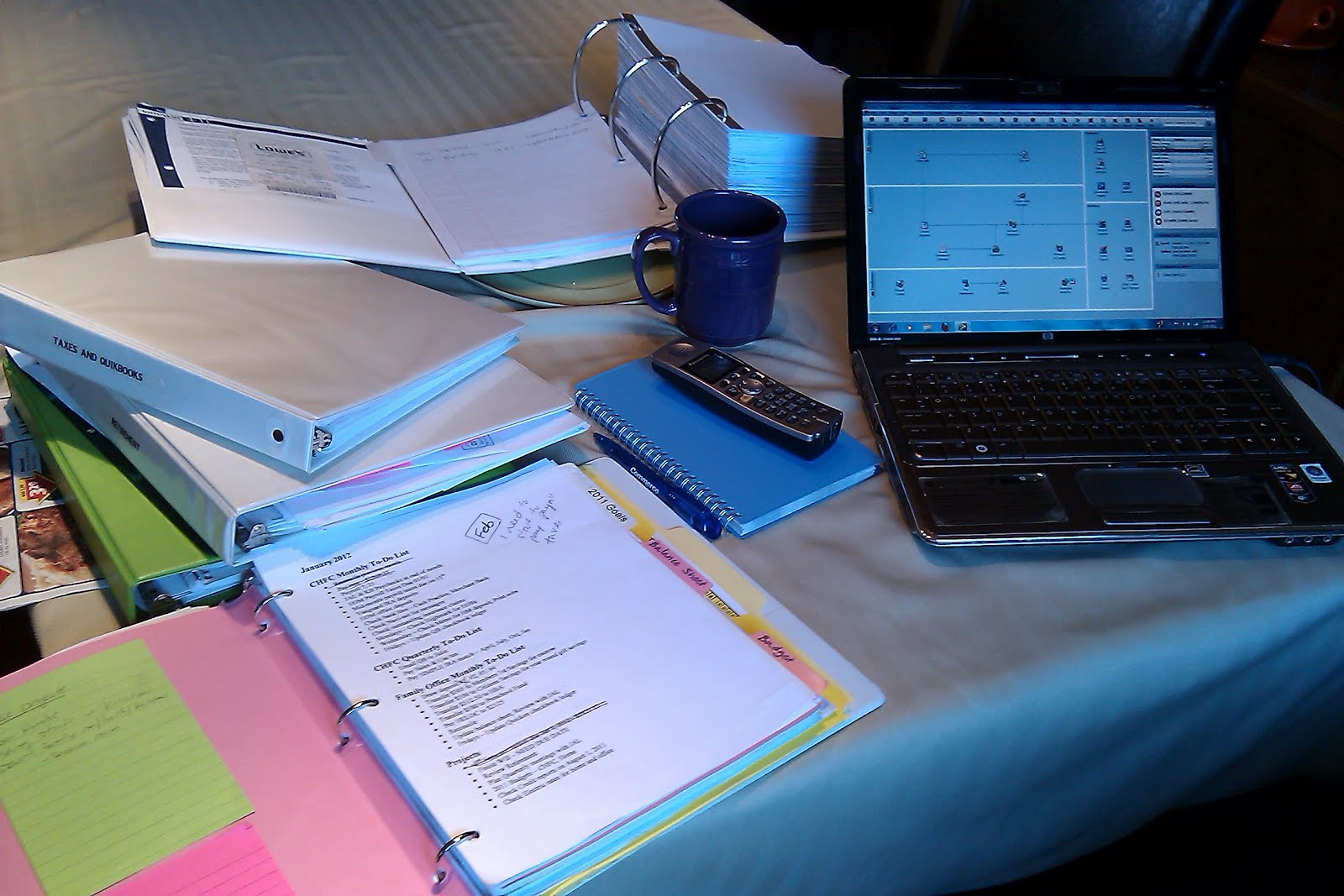
My Binder System for Organizing My Office and My Life


I am a binder queen. I keep binders for many different areas of my life: recipes, finances, workouts. They keep me organized and sane in the areas of my life where I could easily lose all sense of control.

My recipe binder is a very important part of my kitchen. It is full of recipes from magazines, friends, and online that I have collected over the years. Some people keep their recipes on the computer, but I prefer my binder with its well-used, splattered pages. The first page in the binder is a master list of my family's favorite, quick fix, healthy meals.


My financial binder holds my monthly to-do list, my yearly goals, our Family Balance Sheet, our family budget, and our business budget and statistics.


I keep separate binders for our Business Expenses & Statements, Business Taxes, Health Savings Account, Retirement, my passwords (with alphabet tabs), and Workouts.

PK (pre-kids), I trained and competed in sprint and Olympic distance triathlons. I am as slow as molasses, but I really had a blast and took my training seriously. Remember, it was before kids, so I had loads of time to train and workout. This year, I am contemplating running a half-marathon this year, so I got out my Training binder. I use this binder to store training plans, articles, and my training calendar.


I had to chuckle when I saw my training calendar from 2004, the year before our first daughter was born. I wrote "Loser" on June 24 and the funny thing is I remember doing it. I totally blew off my workout that day.


Aside from the large 4 inch binder for our office expenses, I haven't spent a fortune on these books. They were all bought during the back-to-school promotions at Staples or Office Max for about $1 each. I am a bit obsessive about them being all white. I find it visually calming. But I have seen a variety of binders at yard sales and thrift stores for pocket change.

Do you use binders to stay organized? Let us know in the comments.


If you would like to receive FREE updates of FBS, there are four ways to do so:


Tuesday, January 18, 2011

Create a Monthly To-Do List To Keep Yourself On Task


Like everyone else, it always seems like I have too many balls in the air at once. I am a wife, mother, home manager, business manager for our small business, and a woman who would also like to read an occasional book or maybe take an occasional yoga class.

Around the time our second daughter was born, I found myself so overwhelmed and distracted that I missed paying the rent for our business office. I also got severely behind on some Quickbooks work for our business. Important tasks were slipping through my sleep deprived mind.

I had to refocus and basically suck-it-up. We are self-employed; no maternity leave for me.

I developed a monthly to-do list. It is broken down by my office jobs: business office, home office, and projects. It is filled with tasks that MUST be accomplished on a regular, timely basis. Tasks might be as simple as 'reconciling' or more complex like 'paying the payroll taxes'. I definitely have 'Pay Rent' on the list.

It is a visual reminder that I keep on my desk so I am able to glance at it daily. At the end of each month, I prepare the following month's list and make any changes for that month, but most of the tasks really don't change much, except for the 'Projects' list.

This simple, yet effective, list has saved me a lot of stress and time. I find great satisfaction in crossing off the tasks when they are complete...especially the 'pay the rent' task.

How do prevent those regular, yet important, tasks from slipping through the cracks?

If you would like to receive FREE updates of FBS, there are four ways to do so:

Tuesday, October 12, 2010

Is Clutter Interfering with Your Road to Financial Freedom?


Do you have a place that is designated as your home office? A place where you pay your bills, manage your accounts, and research purchasing and investing decisions.

What does it look like? I’m not talking about the decor, I am talking about the organization of it.

I have a corner in our basement for my home office. I snapped this photo one day when I almost snapped after a pile of papers fell to the floor.

In my own defense, I was working on a project for our business, but lately my desk stays like this even after my project is finished. There were piles that needed to be sorted and papers spilling out of my inbox.

It’s not that I don’t have a system. I organized my filing cabinet months ago and it has stayed that way. I throw junk mail away immediately, but for some reason papers have piled up on my desk. Maybe I am saving too much or maybe I’m just not filing in a timely manner, probably a little of both.

I have cleaned off my desk before, but the clutter monster came back.

Does clutter interfere with our Road to Financial Freedom? Could this clutter be holding me back from really accomplishing the tasks on my to-do list?

Clutter interferes with my priorities. I am almost paralyzed by it at times. When I should be knocking things off my to-do list, I sit staring at the piles or simply moving them from one corner to another in an effort to clean off my desk.

With a clean desk, an empty inbox and an organized filing cabinet, I plan on attacking that to-do list.


Is a clean desk a guarantee that you will find financial freedom? No, but maybe it is a good start.

What does your home office/work space look like? Has it been taken over by clutter? Take some time and wipe it clean and see how much better you feel and how much more motivated you become.


Thanks for reading FamilyBalanceSheet. If you would like to receive FREE updates of FBS through your RSS Feed, please click here to sign up. Or Subscribe by Email.

Wednesday, July 28, 2010

Flexible Spending Account and Health Savings Account Participants: Be Aware of Changes For 2011


We were surprised recently with an article in our newspaper about future changes for Health Savings Accounts (HSA) and Flexible Spending Accounts (FSA) scheduled for 2011.

For a variety of reasons, my husband and I chose a high deductible health insurance plan when I left my corporate job with insurance benefits and we needed to purchase individual health insurance. To coincide with our high deductible health insurance plan, we opened up a health savings account.

For those of you not familiar with Health Savings Accounts (HSA) and Flexible Spending Accounts (FSA), they are accounts that allow Americans to pay for medical expenses with pretax dollars.

An HSA can be opened with a high-deductible insurance policy. The account holder can deposit pre-tax money into the account up to the yearly maximum of $6150 for a family and $3050 for an individual. This money can be used at any time for qualified medical expenses. Any money not used by the end of the year can continue to stay in the account and there are penalties and taxes if the money is withdrawn for non-medical uses.

With a FSA, an employer offers employees the ability to set aside pre-tax income into their account to be used for qualified medical expenses, but the money in the account must be used by the end of the year.

Welcome 2011

In years past, participants in these plans could use these accounts to purchase over-the-counter medicines, but that will no longer be the case for 2011. Things like cough, cold and flu remedies, pain relievers, allergy and sinus relievers, antibiotic products, baby rash creams are just a few examples of products that could be purchased in the past with these spending/savings accounts. But in 2011, if you want to purchase these products and use your spending/savings accounts, you will need a prescription from your doctor.

Some over the counter products can continue to be purchased without a prescription from your doctor, such as bandages, contact lens supplies, denture adhesives, first aid supplies, just to name a few.

I feel very fortunate that we don’t use too many over-the-counter remedies. But in the past, if I needed something like diaper cream, I purchased the product using our health savings account. I’m not so sure I will be calling my doctor requesting a prescription AND driving to her office to pick up the prescription for a $5 item. For me, the time involved just won’t make it worth purchasing the item with pre-tax money.

It remains to be seen how medical practitioners will deal with the request from their patients with these accounts. The article made it sound like a lot of doctors are not aware of this change and what could be an onslaught of phone calls.

It also suggested that many account holders are not aware yet of this change. And quite frankly, if I hadn't read the article in the newspaper we would not have known about it. We have yet to receive anything from the bank of our health savings account.

And what about the pharmacies? I used to be able to purchase an over-the-counter product anywhere it was sold and use my HSA. With a prescription, does that mean I can only get those items at a pharmacy after showing my script to a pharmacist? Does this all sound time-consuming to you too?

Between now and December 31, 2010, if you have the funds in your spending/savings accounts, you might want to stock up on the over-to-counter products that you use regularly. This will save yourself the aggravation of asking your doctor for a prescription and you will still be able to use your tax-advantage account. In 2011, you will have to ask yourself if it will be worth your time to seek a prescription from your doctor for a simple over-the-counter remedy just so that you can use your spending/savings account.

Hopefully some more information will be coming soon from our employers or banks. When I find an official list from the IRS, I will publish the link for you.

Do you have a flexible spending account or health savings account? Did you know about this change?

Disclaimer: I am not a financial or insurance professional. If you have questions and concerns about your Flexible Spending Account or Health Savings Account, contact your employer or administrator of your account.

Thanks for reading FamilyBalanceSheet.

If you would like to receive FREE updates of FBS through your RSS Feed, please click here to sign up. Or Subscribe by Email.

Image: jscreationzs / FreeDigitalPhotos.net