Showing posts with label Organic. Show all posts

Monday, September 3, 2012

How to Freeze Basil


I didn't bother growing basil in my garden this year, because we always receive such large quantities from our CSA. I froze the last batch that we received to use later in the fall and winter when I make a lot of soups and casseroles.

It is fairly easy process, but you can't just put the basil leaves in the freezer like I do when I freeze other herbs. The basil leaves will turn black in the freezer. Instead I made a basil puree and froze in 1 tablespoon portions.

How to Freeze Basil


1. Remove the long stems from the basil, leaving just the leaves. Rinse the basil and dry using a salad spinner or squeeze out the excess water with a clean towel.

2. Place the basil leaves in a food processor and start pureeing the leaves. Slowly drizzle extra virgin olive oil into the food processor while it is running. Use approximately 2-3 tablespoons of the evoo for every 2 cups of packed basil leaves.


3. Spoon the pureed basil into an ice cube tray, about 1 tablespoon per cube. Place int the freezer.


4. Once frozen, move the basil cubes into a freezer bag. Label the bag. Use the fresh basil into soups, stews and casseroles.


Related articles:

How do you preserve fresh basil? Let us know in the comments.


Thanks for reading. If you would like to receive FREE updates of FBS, there are four ways to do so:
Follow Me on Pinterest

Wednesday, May 25, 2011

The Number One Way We Save Money on Organic Food


Something very exciting happened at our house this week. We picked up our first share of local, fresh, organic produce from our CSA for the season.

CSA stands for 'Community Supported Agriculture and it is a commitment between local farmer/s and community members who pay the farmer for a seasonal membership. Each week the member receives a pre-purchased and pre-determined amount of produce and the farmer receives upfront money to run their operation. Some CSAs might require the members to volunteer hours on the farm in return for the produce.

This is our ninth year as a member of a CSA and it has proven to be the most cost-effective way for us to afford organic produce. During the May-November harvest season, we receive a weekly share of produce. We supplement with produce we grow ourselves and I rarely need to buy produce at the grocery store during those months.

This year's price for our half-share comes to about $14.21 a week in organic produce. Obviously, prices will differ by farm. The above photo is the share that we received this week and it included baby lettuce mix. broccoli, spinach, new red potatoes, spring onions and carrots. The share at the beginning of the season is always lighter than what we will receive as the harvest season goes into full swing.

Our CSA also offers ‘OPEN Farm Days’ one Saturday each month from June through October. On these days, members can pick up any free extra produce that the farm has an overrun on. They also offer some extra produce at an extremely reduced rate. Last year I bought several 19 pound boxes of organic Roma tomatoes for $6 each. Again, each CSA will operate differently.

Every year, I consider quitting our CSA. I have dreams and delusions that I am going to expand our garden. But I have limited space and the variety of produce and herbs that I receive each week from the CSA is much larger than I have room to grow myself. So every year we sign up again and I never regret it.

How important is eating organic food to you? What is the number one way that you save money on organic food?


Thanks for reading. If you would like to receive FREE updates of FBS, there are four ways to do so:


This post is linked to Frugal Friday at Life as MOM.

Wednesday, March 16, 2011

How To Save Money on Organic Food | Kitchen Economics


Is eating organic food important to you? I don't like the thought of all of the pesticides, synthetic hormones and antibiotics passing through to my family, especially my two young children. So we eat a fair amount of organic, especially during the summer harvest. Have you ever eaten an organic, local, ripe strawberry?...heaven on earth.

Does the price of organic make you not buy as much as you would like? Eating organically can be expensive, so I am always looking for ways to save money on organic food.

When it comes to organic food, everyone's line in the sand is different. I have friends who are adament about eating only organic food and I have friends where eating organic is not a priority. We fall somewhere in between.

Here are 6 tips that I use to help us afford organic food:

1. Community Supported Agriculture or CSA.
A CSA is a commitment between local farmer/s and community members who pay the farmer for a seasonal membership. Each week the member receives a pre-purchased and pre-determined amount of produce and the farmer receives upfront money to run their operation. Some CSAs might require the members to volunteer hours on the farm in return for the produce.

We have been a member of a CSA for 9 years and it is the most cost-effective way for us to afford organic produce. During the May-November harvest season, we receive a weekly share of produce. Most of the produce that we consume during those months comes from the CSA. We supplement with produce we grow ourselves and I rarely need to buy produce at the grocery store during those months.

This year's price for our half-share comes to about $14.21 a week in organic produce. Obviously, prices will differ by farm. The above photo is an example of our weekly share in August when the box is full of high summer produce.

Our CSA also offers ‘OPEN Farm Days’ one Saturday each month during the harvest season. On these days, members can pick up any free extra produce that the farm has an overrun on. They also offer some extra produce at an extremely reduced rate. Last year I bought several 19 pound boxes of organic roma tomatoes for $6 each. Again, each CSA will operate differently.


I found a CSA farm directory, but you should also google to find one in your area.

2. Consider your grocery store's private label organic brand.
Just like non-organic food items, I always try the store brand to see if I/we like it. My good friend loves our store's private label vanilla organic yogurt and I didn’t care for it and went back to my beloved Stonyfield French Vanilla yogurt. Although, I don’t mind the store brand organic milk and that is usually what I purchase unless I have a brand coupon that makes the price better. It is a matter of preference, but worth some comparison shopping.

Here is a quick price comparison on a recent grocery trip:
  • Name brand 32 oz. organic yogurt $2.99 vs. store brand 32 oz organic yogurt $2.53.
  • Name brand half gallon of organic milk $4.05 vs. store brand half gallon organic milk $3.49

3. Compare price per unit and if the size makes sense go for the best price per unit.
  • Stonyfield Organic yogurt, 32 oz @ $2.99 = $1.50/lb, 6 oz cups @ .79 cents = $2.11/lb.
  • Horizon Organic Milk - half gallon @ $4.05, gallon @ $5.99

4. Look for organic or natural meat that has been marked down.
Marked down poultry or meat is safe as long as you use it or freeze immediately after you buy it. I wrote about marked down meat before and I regularly find this type of poultry or meat marked down at my store.


5. Visit your local farmers markets for organic produce, meat, poultry and dairy.

6. Visit the websites of companies that you enjoy.

Go to the websites of your favorite organic companies to look for coupons. Here are some links to a few organic sites that offer coupons. Generally there is a limit, but it usually resets every month.

How important is buying organic food to you? Do you have any tips for saving money on organic food? Let us know in the comments.

Thanks for reading. If you would like to receive FREE updates of FBS, there are four ways to do so:

Follow Me on Pinterest

This post is linked to Your Green Resource at A Delightful Home and Frugal Friday at Life as MOM.

Monday, December 6, 2010

Cooking with Hakurei White Turnips


Prior to a few weeks ago, I had never cooked with turnips. I most certainly never bought them in the grocery store; I never ever considered it. I never gave turnips a thought.

But a few weeks ago, we received turnips in a couple of our weekly shares from our CSA. They weren't just any turnips, they were Hakurei White Turnips. After some web investigation, I found that these turnips were called "salad turnips" and were best eaten raw.

I cut a small one up to try. It was crunchy, slightly earthy, but I couldn't just eat it raw, so I added it to a few recipes in my repertoire.

I replaced the radish (pictured below) in my Radish Canapes with a thin slice of turnip. Not a bad little afternoon snack. I like this snack with dill.


I ran the radishes through the food processor and added them to my Purple Cabbage and Broccoli Slaw. Honestly, I couldn't even taste them with all of the other veggies in the salad, so if you are a little unsure about turnips this is a great way to mask them when eating raw.


Finally I cooked them with garlic and potatoes and made Smashed Garlic Potatoes & Turnips. Apparently, these turnips are best eaten raw, but these smashed potatoes were delicious and so easy to make.

In a large soup pan, add 2 lbs. potatoes, 2 large turnips, 3-4 garlic cloves and cover with water. Bring to a boil and add 2 Tbsp salt. Reduce to a simmer and cook for 20-30 minutes until soft. Reserve a cup of the water and set aside. Drain the rest of the water. With a potato masher, add enough potato water and/or sour cream and smash the potatoes until you get your desired consistency.


Do you like turnips? What is your favorite way to eat them?

If you would like to receive FREE updates of FBS, there are four ways to do so:

This post is linked to:

Thursday, August 26, 2010

Lawn Care: To Treat or Not To Treat, That Is The Question?

Recently I heard a knock at my front door and when I answered the door the conversation went like this.

guy dressed in a uniform: "Hello ma'am, I am working in the neighborhood and I thought I would stop by and give you information about my company. I can help you with this clover patch in your front yard."


me: (I immediately recognize the uniform, they have stopped at my house many times before) "Thank you for noticing my yard, but we don't treat our lawn.(obviously) I have kids and a dog(well, we had a dog, but he doesn't need to know that) and I don't want the harmful chemicals in our yard. I also don't want the harmful chemicals running off into the water basin."

guy dressed in a uniform: "Our products are completely safe. We treat the lawns of some local day cares. We just ask that you wait about 1-2 hours after an application before you walk or play in the yard. Did you know that clover attracts bees?"

me: "Why no I didn't know that, but we are not interested. Thank you anyways."

guy in uniform: "Thank you and have a good day."

The above conversation was very polite and the lawn man was courteous and took my "no thanks" well and went on the the next house with a disastrous yard. These guys have stopped by before. They no doubt are in the neighborhood treating lawns, I see the trucks quite a bit and many of our neighbors have beautiful lawns without a single clover or bee. I know that some of the neighbors do the lawn care themselves too.

As much as I would love a beautiful, lush lawn, we decline these promotional offers for several reasons:
  1. Like I told the guy in the uniform, we have kids and at one time a dog and I don't like the chemicals on the yard. My kids are outside playing all summer long, I have a hard time believing that the chemicals aren't harmful.
  2. Water run off. After a rain, the water runs off the treated yard, down the street and into the water pipes, and, in our case, eventually reaching the Chesapeake.
  3. Bees are good for my garden.
  4. Finally...money. As much as I would love a beautiful, lush lawn devoid of weeds, I am not willing to pay for it. Some of our neighbors try to save money by treating the lawn themselves with products that can be bought in a store, but, for me, also see #1 and #2.

Our approach to lawn care has been:

  1. My husband mows when the lawn needs mowed. With all of the rain we have had in the northeast this summer, he has mowed about once a week.
  2. He usually lets the grass clippings lay, although I have read that is not a good idea when your yard is pretty weedy, regardless the clippings remain on the ground.
  3. ...........ahhh that's it.

Good news about my clover mess, in my search on-line, apparently clover is not a weed and is actually good for your lawn, so THERE, mister guy in uniform!

Do you treat your lawn chemically, organically or not at all?

Thanks for reading. If you would like to receive FREE updates of FBS, there are four ways to do so:

Follow Me on Pinterest

Wednesday, April 14, 2010

Topsy Turvy Strawberries - An Experiment

A couple of months ago, we were in a Bed Bath and Beyond looking for sheets, when I stopped dead in my tracks...


...A Topsy Turvy Strawberry planter. You mean I can grow strawberries now even though I don't have the lawn space. I started shaking and flailing my arms in excitement as I ran to show my husband, who was like, 'that's nice, can we just pick out some sheets?'.

You see, Strawberry season for me is right up there with the Christmas holidays. It is one of my most favorite times of the year. It is a short, but sweet season. One filled with many trips to the u-pick farm to harvest the precious bounty. It is a season filled with strawberry shortcake, strawberry ice cream, strawberry pie and strawberry sundaes. And now I can grow them myself. Life is good!

I didn't buy the planter at that time, because it was a little early. And even with all of that excitement, I actually forgot about it. But then Frugal Babe reminded me of them when she wrote about her new Topsy Turvey Planters and I was at BB&Beyond in about 5 minutes flat.

I am not familiar with the Tomato version of the planter, but I assume it is similar. The strawberry version cost $12.99 and I used a 20% coupon. The box states that the planter holds between 15-30 strawberry plants and the average yield of 15 strawberry plants is up to 15 quarts with proper care, feeding and sunlight.

I headed to a local nursery who was selling a package of 25 strawberry plants for $10.99. I also picked up a bag of good, organic potting soil. Overall, I spent about $30, but strawberries are perennials, so if all goes well they will last for years...I'm going to cross my fingers.

The 25 strawberry plants were so tiny.


The instructions were very easy to follow. I found it easier to fill the planter while it was hanging on a shepherd's hook that I already had.


I'm not quite sure the shepherd's hook is going to hold the planter. It got very heavy once filled with the plants and soil and then I had to add the water. My husband isn't a welder like Frugal Babe's, so I'll have to come up with another option.


I hope my experiment is successful. As a side note, I bought 'everbearing' strawberry plants versus the 'junebearing'. Apparently they yield through out the summer instead of just a few weeks in June....we'll see.

Have you seen these Topsy Turvy Strawberry planters? Are you going to try them out? Or are you are lucky enough to have an in-ground strawberry patch? We'd love to hear about it in the comments.


Thanks for reading FamilyBalanceSheet.

If you would like to receive FREE updates of FBS through your RSS Feed, please click here to sign up. Or sign up for FREE email updates, by submitting your email address in the top left side of this site. Or click here to follow me on Twitter.
This post is linked to:

Tuesday, March 2, 2010

Ten Simple Strategies For Easier Meal Planning

I have steadily been reducing our grocery budget since October. I used to hover around $500 a month for our family of 4. In January, I was able to get it down to $290 by going on a Spending Diet and participating in the online Eat From The Pantry Challenge.

But $400 seems to be where I have settled at right now. I'm okay with this number because it still allows me to cook the way I like (mostly from scratch) and provide my family with healthy, whole foods.

One of the biggest ways I have been able to save money on groceries is by planning our meals. It takes a little time and effort, but the rewards are a reduced grocery bill, no worries at night about 'what's for dinner', and hopefully a less stressed cook in the kitchen.

Ten Strategies for Easier Meal Planning:

  1. Pick a day that works best for you to be your meal planning day. Mine is usually on Sunday afternoon when I have the grocery flyer(s) in front of me. I personally try to keep my large weekly grocery shopping to one store unless there are some irresistible loss-leaders elsewhere. My eye is always looking for great sales on our staples like chicken, turkey, fruits, vegetables, bread, laundry detergent, and toilet paper.

  2. Keep your pantry, freezer and refrigerator organized so that you can cross reference what is on sale, the ingredients needed for a recipe and what you have on hand.

  3. Find a blank calendar or notepad and designate it as your meal planning calendar. I use a free calendar that I received in the mail back in December.

  4. Get the family involved. Ask THEM for suggestions. Every week when I ask my 4 yo, I inevitably hear, "I want pasta". I make one pasta dish every week for my little sweet pea.

  5. On your designated planning day, pull out the family activity calendar. What is going on in the week ahead? Will everyone be home for dinner that week? Is there soccer practice, mid-week church activities or a late night at the office? On those hectic nights, quick and easy meals will be needed. Maybe even a crock-pot meal. Are you going to a pot-luck that week or somewhere else that would require you to make and take a dish? I make those notes on my meal calendar and then fill in the blanks for the meals where we are home.

  6. Plan for breakfast, lunch and dinner. On hectic mornings, life is so much easier when breakfast is planned and there are ingredients on hand. Also, my husband tries his best to come home several times a week for lunch, so I need to make sure there will be food for him.

  7. Plan for all seven days. I've been lazy in the past and just planned for the work week and ignored the fact that we do need to eat on the weekends. We usually eat out one night, but if I don't plan the other six days, then it becomes more than one night out and we end up over budget in that category.

  8. Create a family recipe binder. My binder is a very important part of my kitchen. It is full of recipes from magazines, friends, and online that I have collected over the years. Some people keep their recipes on the computer, but I don't have a convenient spot to keep my laptop when I am cooking, so I keep my favorite recipes in a binder. The first page in the binder is a master list of my family's favorite, quick fix, healthy meals. It is a quick reference tool, but I don't list all of the recipes in my binder, just the family favorites that are a regular part of our meal rotation. When I look in the freezer and see several packages of ground turkey, I then look on our list under Turkey for recipes.

9. Avoid boredom by trying at least one new recipe a week, maybe on a day that isn't hectic. For those hectic days, refer to your Master recipe list for easy suggestions.

10. For new recipes, use websites such as CookingLight.com, myrecipes.com or allrecipes.com where you can enter a particular ingredient and the site will recommend recipes for you. This is how I found Turkey, Arugula and Sun-Dried Tomato Pasta, one our my family's favorite meals.


For me, meal planning is the strategy where I save the most money on groceries. By planning our meals around what I have on hand, what is on sale at the grocery store and what my family likes to eat, I have been able to reduce our grocery bill by about $100 a month.

Do you plan your meals? How often do you plan? Weekly, Bi-Weekly, Monthly? Let us know in the comments.


Thanks for reading FamilyBalanceSheet.

If you would like to receive FREE updates of FBS through your RSS Feed, please click here to sign up. Or sign up for FREE email updates, by submitting your email address in the top left side of this site.

You can also follow me on twitter at twitter.com/fambalancesheet.

This post is linked to:

Wednesday, November 11, 2009

How to Roast Butternut Squash

My daughter said to me, "Look Mommy, a squash family." Out of the mouth of a four year old.

Recently I found myself with a butternut squash family living in my kitchen. We received some with our regular weekly CSA share. And I picked up a few at the "extra" day our CSA held a few weeks ago. Once a month during the season, the organic farm that supplies our weekly CSA share holds an "extra" day for members to drive up to the farm and pick up FREE extra produce. It is wonderful and makes the CSA even more valuable.
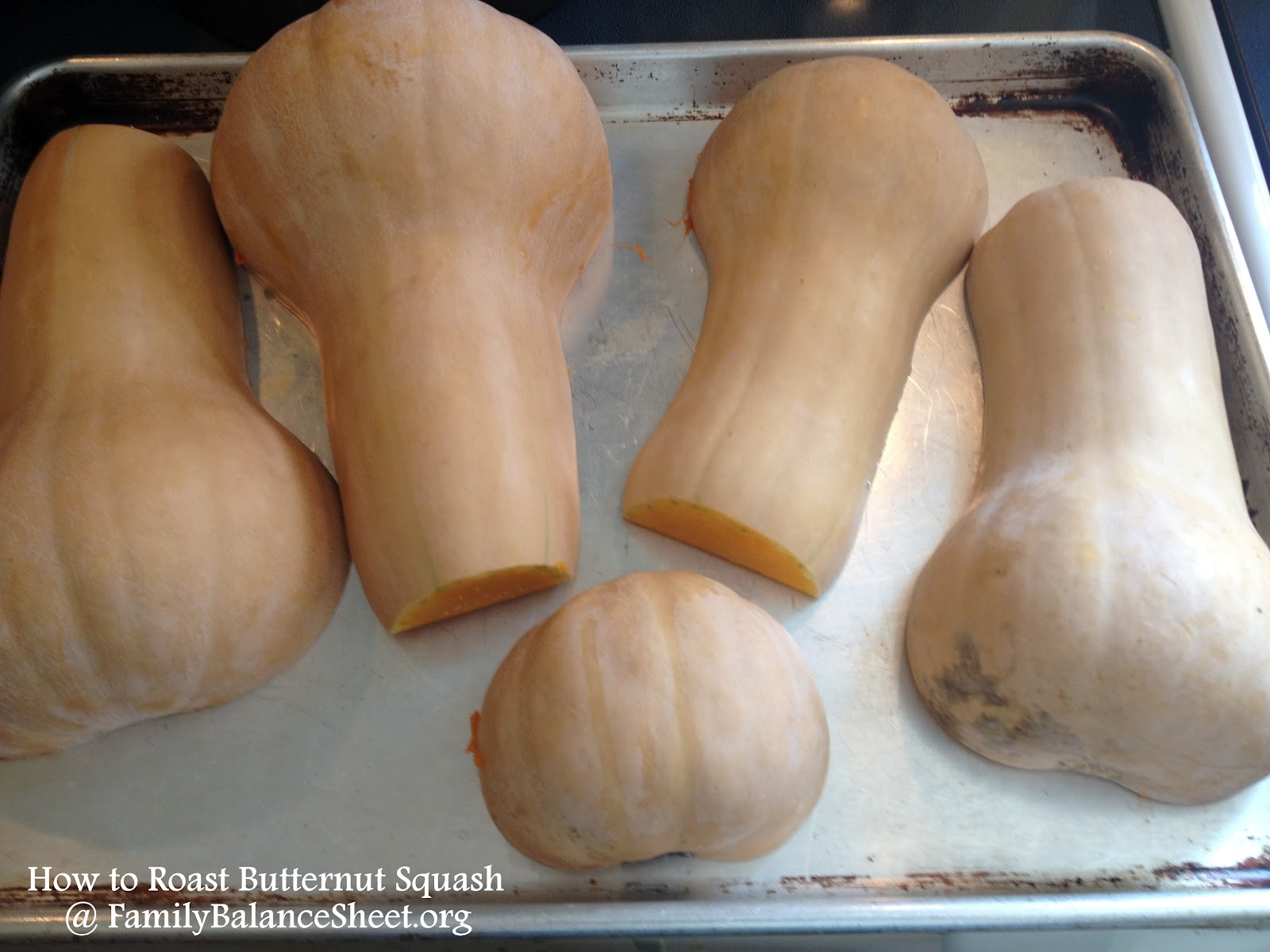
Butternut squash is packed with Vitamin A, beta carotene and is a source of fiber. It can be used as a substitute in any recipe that calls for pumpkin.

Even though butternut squashes keep fairly well, I decided to roast them to put in the freezer for future use. It is very easy.

Slice the squash in half lengthwise and place downward on baking sheets.


Bake at 350 degrees for about an hour. You should be able to pierce the squash all the way through with a fork when it is done.


When cool enough to handle, flip the squash over and scoop out the seeds. I discard seeds into my compost.


Scope out the pulp and put into containers for freezing or use right away in your favorite recipes.

I was able to freeze five 2-cup containers of the roasted squash. I will post some of my favorite butternut squash recipes in the next few weeks.

Butternut squash makes great baby food. Last year, when my toddler was a baby, I pureed the roasted squash until I got the desired consistency for her and put into ice cube trays to freeze. I stored the frozen squash cubes in a freezer bag. It was wonderful to have homemade organic baby food and it was so much cheaper, healthier and tastier than store-bought.


Thanks for reading. If you would like to receive FREE updates of FBS, there are four ways to do so:
Follow Me on Pinterest

This post is linked to the Ultimate Recipe Swap at Life as MOM and Frugal Days Sustainable Ways.

Wednesday, February 4, 2009

Spring must be around the corner - I got my CSA registration!!

It is frigid outside and that darn groundhog saw his shadow on Monday so now we have 6 more long weeks of winter...but I received an email yesterday that gives me hope that spring isn't too far away.

I received my registration form for our local CSA. CSA stands for "community supported agriculture". Our CSA happens to be certified organic and this is how we are able to afford to eat as much organic produce as we do. A CSA is when community members pay a local farmer an annual fee to cover the farm's production costs. In return members receive a weekly "share" of fresh, local, in season produce. Wikipedia's description describes it in further detail.


Our CSA share lasts 28 weeks from May thru November; it usually ends right before Thanksgiving. We purchase a half share which is usually enough produce to last us a week or less, but for us the whole share would be too much. With our CSA, if we prepay by April 1st, our payment is $374 for 28 weeks or $13.36 of organic produce a week. You have to break down the weekly payment to really understand the savings. There is no way I could buy this much organic produce at a grocery store for $13.36 a week. The weekly share follows the local harvest schedule which is posted on our CSA's website. June is one of my favorite months because we get strawberries and if you have never had a local organic strawberry - it is heaven. August and September are BIG months with loads of tomatoes, peppers, onions and summer squashes. I also look forward to fall with the winter squashes, sweet potatoes and kale - yummy!!


Another plus about a CSA is that my family is learning to eat and love veggies that I never would have thought to buy, like kale, swiss chard, and collard greens. This will be our sixth year with our CSA and I had never eaten those three greens before we were members.


While there are still costs with the CSA, I just don't have the yard space or time to garden where I would harvest this much produce. I do have a small garden where I grow a couple of extra tomato plants and peppers for freezing. In another month or so I am going to start to plan out my little garden spot.


Another perk of our CSA is that they have occasional "you pick" days on their farm. They are usually on Saturdays and it gives us extra produce at no additional cost. Our farm also has a potluck picnic sometime during the year and last year at the picnic they gave out extra produce again at no additional cost. I think I came home with at least 3 weeks worth of extra produce such as peppers, carrots, onions, and winter squashes. I promptly cleaned and chopped it up and put it in the freezer.


Is eating organic important to you? Are you members of a local CSA?