Monday, October 12, 2009

How to Make Homemade Sugar-Free Applesauce

Home-made applesauce is family favorite. I don't mind making it because it is very easy to make, especially when you use a mix of fall apples the only ingredient that you need is ... Apples. On a recent trip to a local apple and pumpkin farm I bought two 1/2 bushel bags of seconds for $8.00 a bag. A 1/2 bushel bag of regular apples was $12, but when I saw that the seconds were in really good condition, it was a no-brainer. So I sorted through the bins and my kids helped me fill the bags full with Ginger Gold, Yellow Delicious, Honey Crisp, Gala, McIntosh, Fuji, Jonagold.

I brought them home and got started on the applesauce right away. I also made a pie, but it was gobbled up before I thought about taking a picture.

I have to admit my way of making applesauce is made easier because of this handy gadget, a food strainer and sauce maker. It is a hand-me-down from my mom and it makes the job easy and fast. If you see one at a yard sale or thrift store, it might be worth your investment, as the price sticker is still on this box at $47.95.


Because of my food strainer, all I have to do is wash the apples and cut them into quarters. I don't have to peel or worry about the seeds...you'll see why below. I put a tiny bit of water in the bottom of the pans so that the apples don't scorch and then I cover and cook on medium until they are mushy. Stir often to also avoid scorching.


You can still see some of the slices, but most of what I was putting into the funnel was mushy.


I didn't get a great shot of the whole contraption, but I put apples in the funnel that is in above picture and then I turn the handle (on the right) and applesauce just slides through a screen and right down into the bowl.

The funnel on the right of the picture is the waste funnel. All of the skin and seeds are pushed through that funnel and into my garbage bowl.


This is a picture of the peels and I put them through the strainer one more time and reduced this waste even more as I squeeze out more applesauce.


My finished applesauce. I let it cool and then put into freezer containers. We eat it all year long. I also use it in baking. I went back to the farm and I bought another 1/2 bushel bag and made more sauce. My daughter was invited to a birthday party next weekend at the same farm and I'm sure I'll get another bag or 2 to make even more.

I think the secret to making delicious applesauce is using a blend of your favorite apples. This sauce didn't need an ounce of sugar because I used a blend of 7 apples that range from sweet to tart. In the past I always used Ginger Gold, because that is my favorite apple for pies, but when using them for applesauce I felt it needed a little sugar in to sweeten a bit.

Do you make your own applesauce? What are your favorite apples to use?

Thanks for reading
FamilyBalanceSheet. If you don't already receive FBS free updates, please click here to sign up.

This post is linked to:

photos: familybalancesheet.org


Thursday, October 8, 2009

Cold weather is coming...Seven Tips to Save Money on your Heating Bills.

According to the Energy Information Administration, the average homeowner could see an 8% drop in heating expenses this winter. This much needed relief could come from a milder winter being predicted and lower fuel costs. Homes that heat with electric could see a decline of 2%, while homes that heat with natural gas and propane could see their bills drop 12%-14%. How much households save will also depend on the actual weather this winter (predictors have been known to be wrong before) and the energy efficiency of households and their heating equipment.

While this is good news, it got me thinking about what we can do to reduce our heating bills even more. We currently heat our home with a gas fireplace that is in our living room and baseboard heaters in the rooms the heat from the fireplace doesn't reach. The gas fireplace is situated in a spot that shoots the warm air right up our stairs and heats our entire second floor.

Has the thermostat dance started in your home? Does your spouse turn it up when you aren't looking and you turn it down, or vice versa? I try to maintain a temperature of 68 degrees in our home during the cold months. My husband thinks that is too cold, but I say put on a sweater or a blanket. This week, I washed our extra blankets for our beds and our throw blankets for our TV room. I refuse to buy a "snuggie".
  1. Consider buying a programmable thermostat. Energystar.gov claims that "homeowners can save about $180 a year by properly setting their programmable thermostats and maintaining those settings." An ENERGY STAR qualified programmable thermostat will automatically turn down the heat at night and when the home is unoccupied and turn it back up when the homeowner is scheduled to return home. The settings will also apply to cooling your home in the warmer months. I checked Lowes and a unit runs between $50-$100.

  2. Use your kitchen and bathroom fans wisely. It only takes an hour for these fans to send all your warm household air out the vents. In other words, don't over-use.

  3. Get your furnace, gas fireplaces, and other heating equipment serviced. We had our fireplace serviced last year and the technician suggested every two years for it, but you should check your owner's manual. Our fireplace needed a good cleaning and we noticed a difference in it's efficiency afterwards. Just like your air conditioner, furnace air filters need to be replaced to be efficient. Again, consult your owner's manual for time guidelines.

  4. Close the door and shut the vent of seldom used rooms. Our guest room is mighty frigid in the winter, it is a good thing we don't have too many guests.

  5. If you have a fireplace, keep the fireplace damper closed when you are not using it to prevent heat loss. Don't forget to open it before you start a fire. My husband did that once when we were dating, it wasn't pretty and his roommate was very upset. And when the fire is completely out, don't forget to close it up again. An open damper will allow huge amounts of heated air to escape. Did you know that the fire in that romantic wood fireplace actually sucks the heat out of a room? I didn't, but we don't have a wood fireplace currently. Unless it is your only heat source, you might want to save the wood fireplace for...ahem...romance...

  6. Let the sun shine through your windows on those sunny days, but close those curtains or blinds at night to avoid any heat escaping.

  7. Stop the draft from your exterior doors. Our family room has 3 doorways, leading to our garage, sunroom and basement, that blow cold air into that room in the colder months. We bought some inexpensive draft stoppers to help block the cold air.

Are you ready for cold weather? Do you have any money saving home heating tips?


Thanks for reading FamilyBalanceSheet. If you don't already receive FBS free updates, please click here to sign up.

Tuesday, October 6, 2009

How To Make Homemade Chicken Stock in the Crockpot

Soup season is here and after a long, beautiful summer I am once again turning on my poor neglected oven. When I looked in my freezer last week to get some stock for a recipe, I realized I was out of my homemade chicken stock and the thought of buying it at the store just didn't appeal to me. Luckily, my grocery store had Perdue Oven Roasters on sale at .79/lb and I had a coupon for $1.00 off $10.00 meat purchase, so I purchased two 7 lb. roasters.

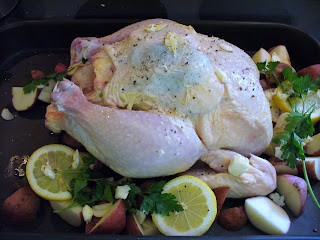
There is nothing like roasted chicken on Sunday afternoon for dinner. It is so easy to roast a chicken. I simply stuffed the cavity with a lemon, cut in half, a big handful of flat-leaf parsley from our garden, salt and pepper. I rubbed the outside of the bird with some butter and sprinkled more salt and pepper on top. I placed some red potatoes around the chicken and topped them with lemon slices, parsley and a little salt and pepper. I popped the bird in the oven and roasted at 375 degrees for about 1 1/2 - 2 hours. The nice thing about Perdue is that their roasters come with pop-up thermometers that let you know when the chicken is done. Otherwise I would use a meat thermometer and roast the whole chicken until it reached an internal temperature of 180 degrees. The thermometer should be placed in the thickest part of the cut of meat without touching the bone, per Perdue's guidelines.

This is my chicken right before it went into the oven...
and unfortunately I forgot to take a shot when it was done roasting and before we dug into it. We devoured quite a bit of the chicken for dinner. I did have enough meat left over to make chicken salad for sandwiches for our lunches for the week. We really look forward to lunch when homemade chicken salad is on the menu.

A disturbing shot of the carcass after my husband cut it up. He loves that job.

I put the chicken bones in the crock pot with a whole onion, chopped into quarters. I didn't have whole carrots, so I threw a handful of baby carrots in the pot. I also added a whole head of garlic sliced in half, a few of the lemon slices from the roasting pan, a couple of celery stalks with leaves, cut into big chunks, a couple of bay leaves, a large handful of parsley sprigs, a few grinds of pepper and about a Tablespoon of salt. I didn't add too much salt, because I salted the roaster before popping in the oven. I filled the crock pot with water and turned it on LOW and left it on overnight.

The next morning when I came downstairs, my kitchen smelled so good and this is what I found. Sorry for the yellow glare.

Next I strained the stock through a sieve and pressed the ingredients down with a spoon to get as much flavor as I could into the finished stock.


Liquid gold...I let the stock cool down and then I put it in the refrigerator until the next day. At that point, I skimmed some of the fat off and put into freezer containers and into the freezer for future use. I use containers of different sizes: 32 oz, 16 oz and 1 cup.

This bowl is 4.5 quarts. I estimate that I made about 4 quarts as this bowl is not all of the way full with chicken stock. I priced store-brand chicken stock at .50 for a 14.5 oz can and brand name stock costing up to a dollar. Four quarts = 128 oz, so I made almost 9 full cans of stock and saved at least $4.50. I didn't take into consideration all of the ingredients that went into roasting the chicken and making the stock. I had everything already on hand except for the lemons. $4.50 may not seem like a lot of savings, but I will do this through out the fall and winter, because we use a lot of stock during those seasons. And the flavor of store bought just doesn't compare to homemade.


Making your own chicken stock is very easy and really stretches your grocery dollar. Things to remember when making your chicken stock:

  • Look for sales on roasting chickens and figure out your "buy" price. In my area, .79/lb is a good price.
  • Find a recipe for roasting chicken that you like because those flavors will carry into your stock.
  • There are tons of stock recipes online, but I use simple vegetables that usually can be found on sale and in my refrigerator.

Do you make your own homemade chicken stock?

Thanks for reading FamilyBalanceSheet. If you don't already receive FBS free updates, please click here to sign up.

This post is linked to:

photos: familybalancesheet.org

Monday, October 5, 2009

Cranberry Walnut Acorn Squash Bowls

I love the flavors of fall. Apples, clementines, pears, pumpkins, and fall squashes. We receive a lot of fall squashes with our CSA share and this is one of our favorite ways to eat acorn squash.

You'll need a sharp chef's knife to cut through these little buggers. I cut the stem off first and then cut the squash in half lengthwise. Be very careful.

You'll need these fine ingredients too.

Scoop out the seeds of the squash. In the cavity of each half, place 2-3 teas. butter, 1/4 teas. cinnamon, 1-2 T brown sugar, 2 T dried cranberries, 2 T chopped walnuts. It is to your taste. My husband doesn't want as much butter and sugar in his as I do in mine.

Place in a casserole dish. Add 1/2 C water to the bottom of the casserole dish. Cover with foil and bake for one hour at 350 degrees. Each half is one serving.


After baking, mix together the flesh and the ingredients within the acorn "bowl" and enjoy.

Thanks for reading FamilyBalanceSheet. If you don't already receive FBS free updates, please click here to sign up.

This recipe is linked to:

photo: familybalancesheet.org

Thursday, October 1, 2009

We are going on a Spending Diet!

It is October 1, 2009 and my husband and I are going on a diet. No, we are not trying to lose weight, we are actually trying to gain weight...to our bottom line.

Last week, I confessed to our excessive spending over the last month or so. I wrote that we needed to put the brakes on. Well the brakes are on and we are at a full stop. As I was entering transactions into Quicken last week I noticed that we have been doing a lot of spending lately, making many unplanned purchases. Some of the purchases were needed, but there were many that were impulsive and hardly necessities. I talked to the hubbs about it and he agreed that we need to take a brake.

The Guidelines of our Spending Diet.
Allowable expenses:
  1. Groceries - of course we need to eat, but I'm going to try to eat more from the pantry and freezer to try to reduce this expense.

  2. Sign up for swim lessons for our oldest daughter is in October.

  3. Her birthday is also coming up and we are going to have a small party with a few of her friends. I haven't planned anything yet, but I will be working on it this month.

  4. I received some gift cards for my birthday for restaurants that we will use if we feel the need to eat out this month. But we must stay within the gift card and our only out-of-pocket expense will be for any tip. This might be our most challenging guideline.

  5. We will still get our cash allowance for the month. Trust me it isn't much.

  6. Our oldest will need a winter coat and I will keep my eye out for a good sale. Although I was planning on avoiding the stores, so I won't be tempted to shop. Let's hope for a warm October!

Disallowed expenses:

7. Everything else.

What are we trying to achieve?

  • Self-Control.

  • How much more will we have in our account at the end of October?

  • What will we do with that overage? How will it best affect our bottom line?

  • How creative can we be so that we avoid spending money on things like food, entertainment, clothes?
Do you care to join us on our Spending Diet?

Thanks for reading FamilyBalanceSheet. If you don't already receive FBS free updates, please click here to sign up.